- The Dance of Death — a very comprehensive old website on this theme in mediæval and early modern European art
- Pirating the Pirates, or, on the underground of film preservation
- To grieve, or not to grieve?: Kevin Buzzard on the new era of mathematics
- Try your own hand at redrawing Europe at the Congress of Berlin! I love the fuckass jaunty tune it plays at the start.
- A strangely relaxing watercolour playground
- Some winning entries in this year’s premier microscopic-photography competition
- Commission on Federal Paperwork: Drawings by Carol, 1976–1977
- Down in That London, a special report from the night of Oxford Street’s pedestrianisation (also, wow, how come Newcastle managed to pedestrianise our main shopping street first?)
- The Odyssey: A Greek Reader
- The New Yorker alleges that Computer Chips Are the Most Magnificent Things Humanity Has Ever Made
- Also thence: a profile of James Daunt, CEO of Waterstones, interspersed with how rumours of literacy’s death have been greatly exaggerated
- St Keyne Wishing Well Halt railway station: “It serves the village of St Keyne, and is adjacent to the Magnificent Music Machines museum of fairground organs and similar instruments.”
- The Flipbook of the Rings
- This is not a drill: Local 58 is back
All aboard the Tanfield Railway
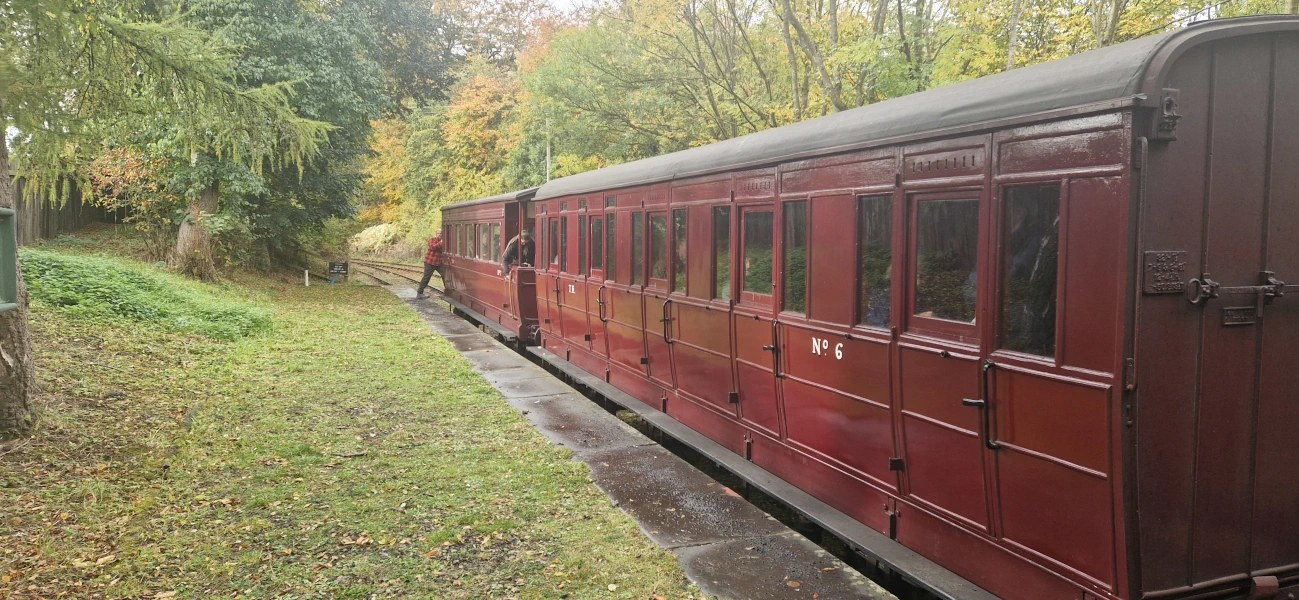
Hello. I’ve been to see some old trains. I thought you might like to hear about it.
The Tanfield Railway likes to brand itself as “the world’s oldest railway”, operating since 1725. It’s the sort of boast that tends to come with asterisks attached, but it’s worded specifically enough that i think it might just be true.
Is it the world’s first railway? Not by a long shot. The use of wheels in rails for transport goes back to the 1550s in Germany, and it was introduced to Britain soon thereafter. If you want to be really pernickety, you could even go back to ancient Greece, where a grooved Díolcos carried sea vessels over the inconvenient Isthmus of Corinth.
Is it the world’s oldest passenger railway? Heavens, no — Wales’ Oystermouth Railway started carrying passengers over by horse in 1807, and the Stockton and Darlington let them aboard its steam trains from 1833, whereas the Tanfield wouldn’t begin its (short-lived) passenger operations until 1842.
But… It is, as far as i can tell, the oldest physical stretch of (non-funicular) railway in the world which regularly carries trains today. Which seems good enough.
I snatched my tickets for the very last day of the operating season, when they were holding their big “gala” event, so if you’re hoping to use this as a visitor’s guide then this post will be utterly unhelpful, sorry. We started our day at East Tanfield, with a vintage bus parked outside, a nice little café, and some live tunes in the reception area courtesy of the Cloth Cappers.
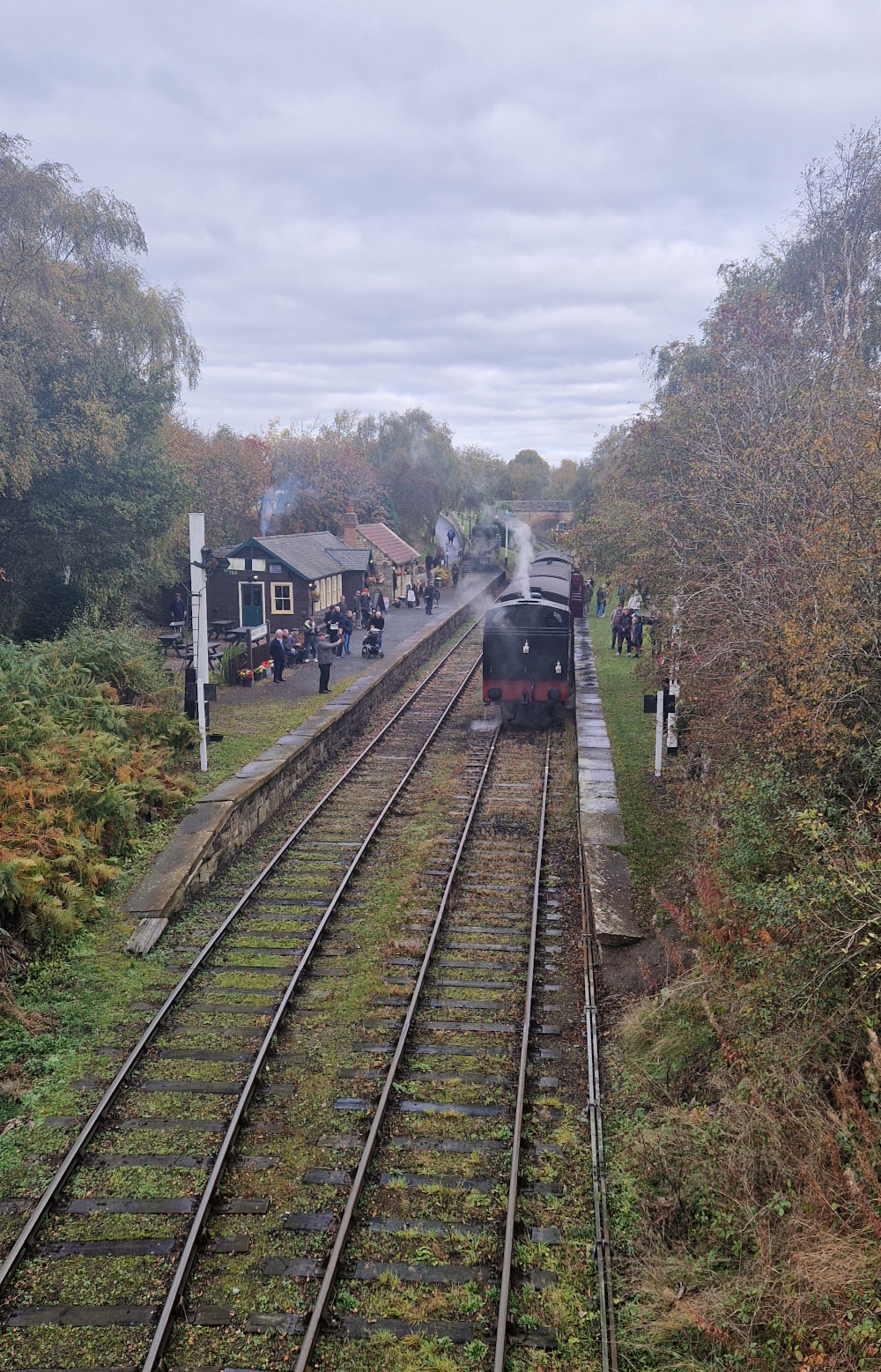
I don’t think i’d ever seen so many flat caps in one place before stepping out onto the platform. While we all waited for a train to arrive, kids and anoraks alike were entranced on the bay platform by Horden, a canny green National Coal Board locomotive making a right show of tooting its horn and puffing away, even if it didn’t have anywhere to go at the moment:

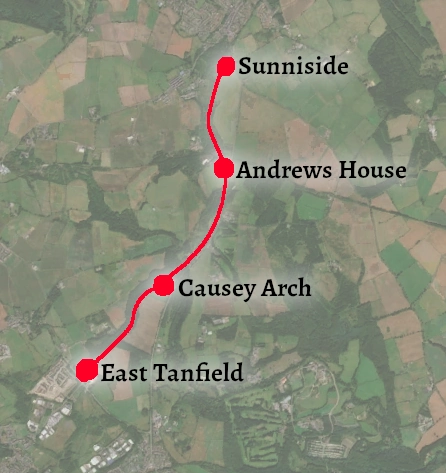
At last, our train arrived, pulled by a wartime loco rebuilt à la Thésée, and i, for my part, shuffled into third class like a good little plebeian. It was a strange mix of cramped and spacious — you get your own little compartment, leaving you free to sprawl wide open if noöne else is in there with you, but it’s easy to imagine people must have been packed in there like sardines back in the day. We sailed past the Causey Arch without stopping, before a brief stop at Andrews House (where i’d be doubling back later) and a subsequent slow ride to the terminus at Sunniside.
Alas, the terminus isn’t particularly photogenic, and there’s not much to see, but it did let me get a good shot of the British Railways badge on the locomotive as it prepared to turn around:

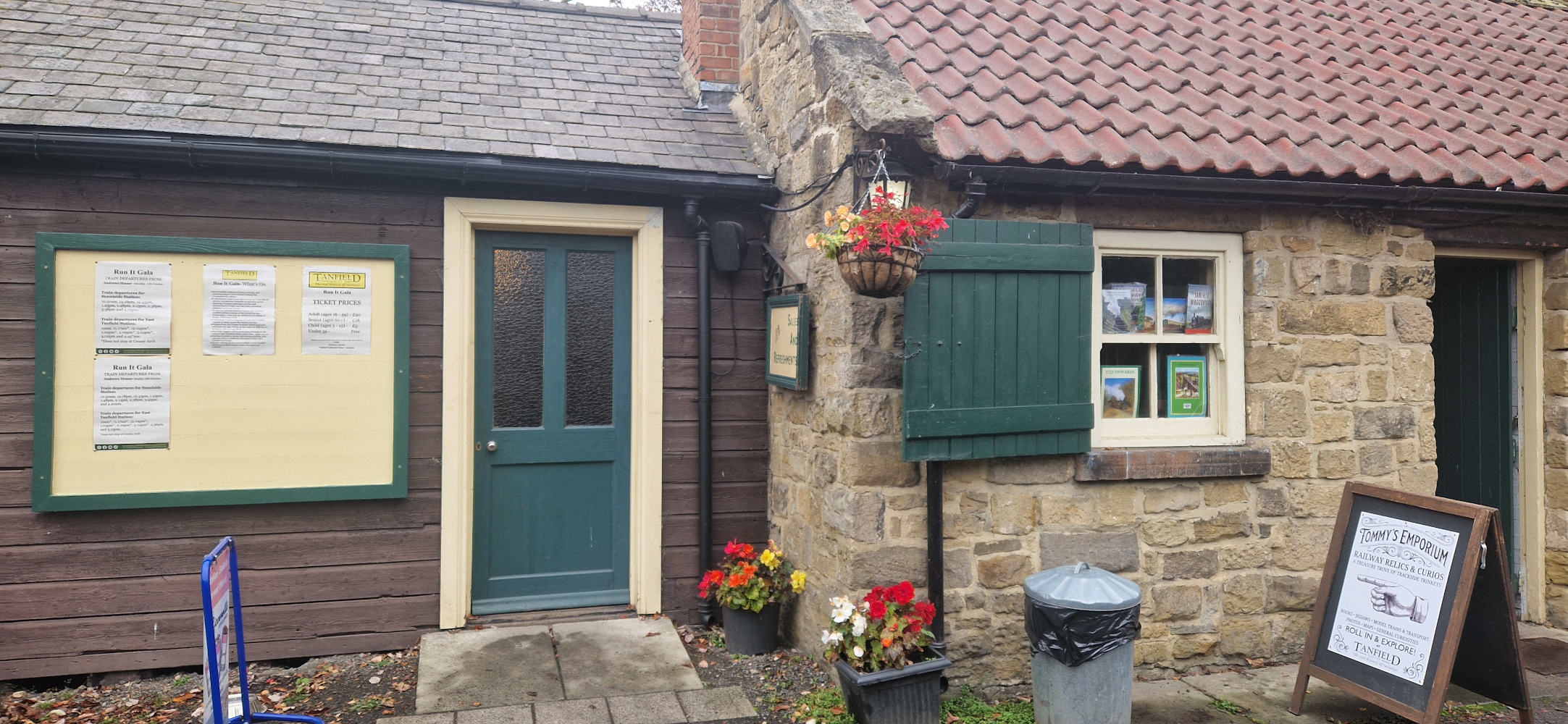
Back at Andrews House is the line’s most substantial station, a cute little cottage featuring a footbridge for easy trainspotting, another café, and, most salivatingly, a used bookshop specialising in trains, trains, and nothing but the trains.1 Obviously, then, i dashed straight in, and after a long conversation with an old man in a jacket who might have been a volunteer or might have just been a fellow nerd, left with three books on the railways that became the Tyne and Wear Metro for just £10. (I’m sure this purchase will provide me much fodder for future blog posts, if i can ever be bothered to write them.)
Finally, just up the hill from there, we find the Marley Hill depot, where trains are fixed up and any old railway artifacts that couldn’t find a better home are stashed. I’m fond of this big British Coal banner myself, because, really, the miners have always deserved their own pride flag too:

On the parking lot between, all sorts of doohickeys were on display, from a vintage steamroller to an army of old preserved buses, for those who like their transport heritage more on the road-going side. The fine people at the North East Bus Preservation Trust were also running the shuttle service back to Tanfield, an old double-decker whose last gasp of normal service was as a converted tourist sight-seer. I climbed straight to the top, like the giddy child i am, which turns out to be less than ideal when it’s six degrees out and windy as all fuck. …And so that’s the story of how i ended my lovely day out shivering my cheeks off on a creaky open-top bus careening down the main road.

Information for visitors
If you, too, would like to see some old trains, then too bad, because it’s closed until the spring. That said, should everything be the same when they start up again, here’s what you’ll want to know:
- Admission: £16.22 per adult, £14.31 per senior, £5.30 per child (or 25% off if you travel by bus)
-
Address:
- Andrews House: Engine Shed, Marley Hill, Burdon Plain; Gateshead NE16 5ET
- East Tanfield: East Tanfield Station, Tanfield Railway, New Front St, Tanfield Lea, Stanley DH9 9UY
- Accessibility: Accessible toilets are available at Andrews House and East Tanfield, and the railway’s official website states that a wheelchair-accessible partment is “usually available”.
- Arriving there: Andrews House is regularly served by the X30, X31, and X32 buses from Newcastle and Stanley.
I am suddenly very relieved that this site no longer runs on PHP.
Mx Tynehorne’s link roundup, volume LXXI
Before we start: in the time since the last roundup, i’ve also added ten new links to the linkroll, all of which are just as good as any you’ll find here. Check ’em out!
- The Internet Archive’s collection of “vintage AI” — mostly in the video-game sense, but there’s some Elizas and other chatbots in there too
- Remember Pink Trombone, that little web toy where you could control a mouth and make it speak? Samuel tries to make it work with real audio of speaking. Spooky!
- Fairly ranking the most brilliant birds
- Giant Pumpkin Statistics and Grower Resource. That’s a resource for giant pumpkins, not a giant resource for pumpkins!
- Holdouts: The Nazi pockets of WWII that kept fighting
- A very good piece of hypertext fiction
- The Eaglemoss Orrery… I need this thing so badly
- Evilstick: “It gained notoriety and media attention in 2014 after a parent bought one at a dollar store in Dayton, Ohio, and discovered that the hidden image in the toy depicted a woman cutting her forearm.”
- Yeah, i’m at the DMV (Deserted mediæval village)
- Acronymy! Or, the quest to define every word in the English language as an acronym. Cringe for example: “common regret is not good enough”.
- The Endless Museum: explore Wikipedia as a 3D place! (via the e’er-reliable Web Curios)
- The Warren: a collection of internet rabbit holes, each of which comes with links to video, text, and audio stories (ditto)
- The Tube Computer (ditto)
- Robin Sloan, always a welcome measured voice on the thinking machine: ‘Ask for what you want’ is a key skill for the 21st century
- How I Vibed a Proof of Conway’s Conjecture
the Yongle Emperor /ˈjɒŋgəl/
Mx Tynehorne’s link roundup, volume LXX
- “Hidden by billboards for over 100 years, the tiny holdout building in the middle of Macy’s is back in view”
- Play around with some dudes in boxes
- Charles Ross’s Star Axis, a colossal land-art observatory in New Mexico, is almost ready
- Vibe Genomics: “Have you ever wanted to perform questionable genetic experiments on yourself from the comfort of your own home? No? That's probably the well adjusted answer. It's not really a good idea. But I felt like other people have already done all the good ideas, so I got Claude to help me – someone with no lab experience – build a wetlab in my spare bedroom and do just that!”
- June McCarroll, inventor of the painted white line in the middle of the road
- Well, i can’t improve on the headline here: Revenge of the Simps — How a community of porn addicts tried to rescue the teenage camgirls they worshipped from the clutches of a violent webcam pimp.
- Why horses have stopped getting faster
- The outlaw chemist teaching people how to make drugs from scratch
- Ordinary Abundance: a catalogue of all the boring inventions in your modern apartment, described by the awe of the people who first used them. It’s Claudeslop, this, but it’s bloody good Claudeslop, and it’s what inspired me to coin the term eutechnia.
- Archive of Archives: a curated collection of digital archives
- “One of the North East’s most delicate plant conservation operations has seen 200 wild orchids lifted by hand and given a new home.”
- Hacking a printer to run a Minecraft server. We are living in the era of “Hey DeepSeek, find an unpatched zero-day exploit for me so I can make a funny Youtube video”.
- The Labyrinth of Polyominoes
- The Museum of Modern Art’s illustrated glossary of art terms. Very useful if you want to swot up on your cultural literacy.
- Place Oddities (via Web Curios)
- The Bre Pettis Collection of Computer Art (also thence)
- New Worlds: “Every day I notice a news story that startles or alarms me, that feels like pure cyberpunk, nestled between reports about council bin collections and cabinet reshuffles.”
- A database of commercially available chairs in Star Trek
- “Artgasm medically manipulates the male audience/participant to experience the maximum of corporal pleasure, ie orgasm. The orgasms are involuntarily induced through a medical device and under the medical treatment of a doctor and nurse. By neural stimulation males will erect and ejaculate within two minutes.” (via qdot)
Just noticed this site’s font’s manicule (☞) character has six fingers… Starting to get suspicious of this Claude Garamond fellow 🤔🤔🤔
Introducing @towns.satyrs.eu
Hello! If any of my (beautiful and sexy) readers are on Bluesky, i thought they might like to know that i’ve made a bot on there. It’s called @towns.satyrs.eu, and it posts a random British/Irish town (or village, or hamlet, or city) on the hour, every hour, give or take a few minutes. Like so:
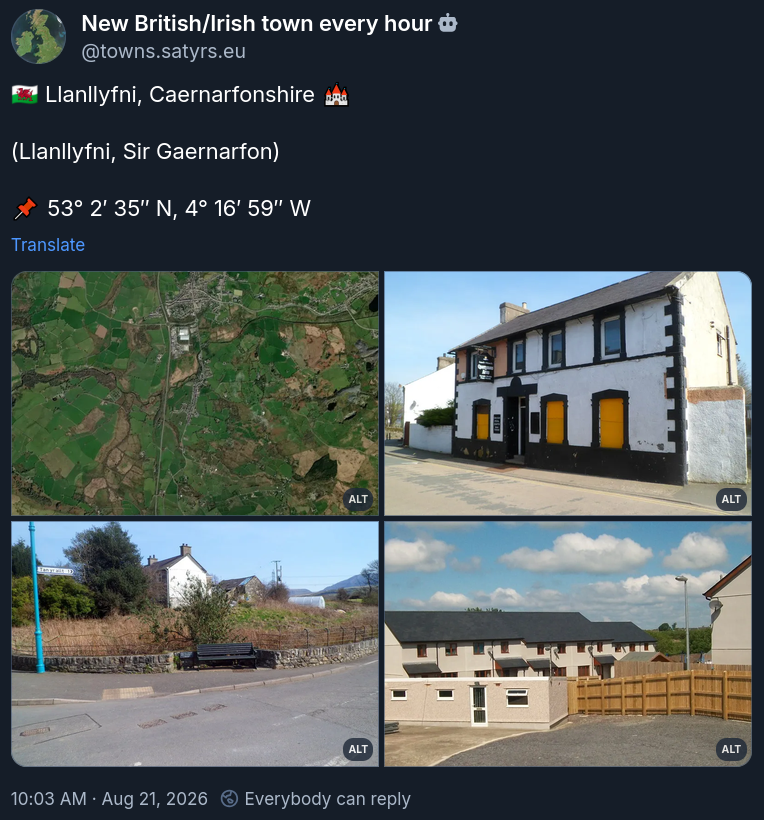
It’s inspired by the inimitable (okay, highly imitable) @townsusa.bsky.social, which does the same thing but for American towns. Here’s how i made it, in bullet-point form:
-
Place data
- From the moment i had the idea, i knew i wanted to use historic counties as the basis, rather than local government areas or the post-1974 bastardisations. I thought this would be a big hurdle — but, thankfully, the most comprehensive permissively licensed database on British place names out there, the Gazetteer of British Place Names, is maintained by none other than… the Association of British Counties! So that was easier than i expected.
- The Irish government maintains its own official dataset of population centres, including both Irish and English names. It’s a bit thinner than its British counterpart, but it serves nicely enough for our purposes. (I had wanted to use Logainm.ie, the even more comprehensive dataset of Irish-language place names, but there didn’t seem to be any kind of download button anywhere… alas!)
- For crown dependencies and overseas territories, i scraped data from OpenStreetMap using the Overpass Turbo API. It comes with its own bespoke arcane query language, but thankfully it’s 2026 and you can just get your friendly local server farm to write your queries for you instead of learning it yourself for questionable future gain.
- OpenStreetMap also sourced most of the Welsh, Cornish, Scots Gaelic, and Irish place names for the UK, where the ABC’s gazetteer was frustratingly thin on the ground.
-
Pretty pictures
- The satellite images are sourced from Mapbox, whose API has a very generous free tier if you can stomach giving them your card information.
- Wikimedia Commons, incredibly, lets you search images by geographical location. The bot asks for the fifty nearest photos in a one-kilometre radius, then picks three from that list at random. (This avoids naïvely picking the three nearest and thus ending up with three pictures of exactly the same thing.)
- Descriptive alt text is generated for the above by Google’s Gemini 3 Flash. At about a fifth of a pence per post — £17.50 per year, otherwise put — i’m hoping it won’t burn too much of a hole in my pocket.
-
Posting
- Posting goes through Bluesky’s native ATProto API, whose documentation even starts with a helpful tutorial for setting up your first bot. That’s nice of them.
Anyway, that’s all. Enjoy, and do give the bot a follow if you wish!
eutechnia (noun)

The Amish are not a people known for their love of the newfangled. They are deeply wed to their traditions, keeping to themselves, keeping the old ways alive, and shunning any sort of Engliſche imposition on their material culture. But there is one technological innovation which even the most stringently conservative have accepted:
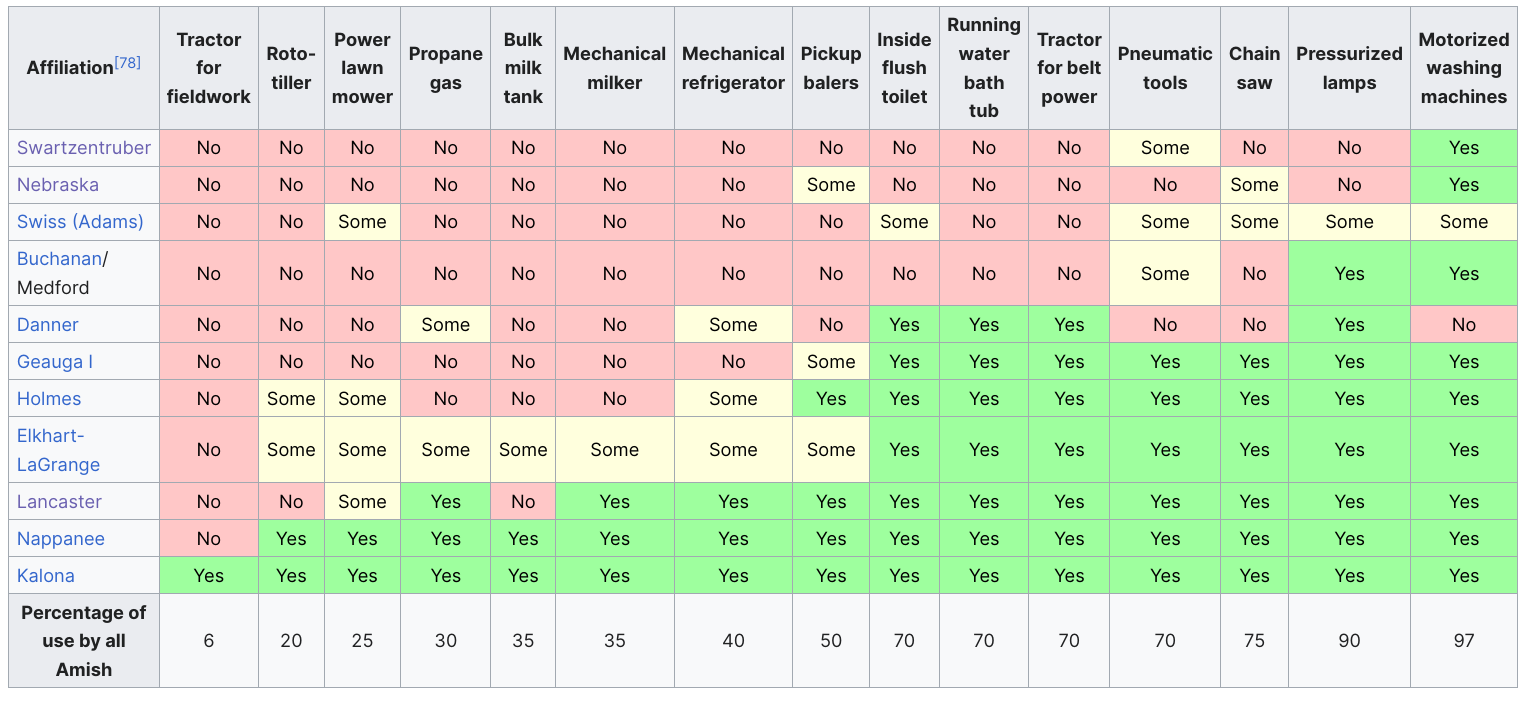
The washing machine may be the most revolutionary invention in human history. (At the very least, it is the most revolutionary in women’s history, and 50% ain’t bad.) We do not often think particularly much of it today; when we do, it is usually because it is making too much noise, broken, or otherwise inconveniencing us. And yet! Think of all the hours saved — the gruelling days of hauling heaving buckets of water, scrubbing down with fat, keeping watch over boiling tubs… To quote the statistician Hans Rosling, on his mother’s first time using the machine:
My mother explained the magic with this washing machine the very, very first day. She said, ‘Now Hans, we have loaded the laundry. The machine will make the work. And now we can go to the library.’
This is the fundamental beauty of a technology applied correctly. It is deskilling as liberation. The liberation of one’s time, the liberation of one’s energy, the liberation of one’s mind to think about things other than merely staying alive.
Over the years, so many of these improvements, big and small, have shaved the drudgery, toil, and pain from our lives. As i write this paragraph, i am taking a sip of water that i can be reasonably sure is pathogen-free, with ice cubes which came from my electric freezer rather than the Arctic. A recording of Carole King’s “I Feel the Earth Move” is playing through my headphones, on demand.
Rarely do we truly appreciate these facts. Once a technology has embedded itself thoroughly enough into society, it becomes just another part of the scenery. “Hasn’t that always been there?” But sometimes, i’ll be out on a walk, and i’ll see a power pylon, and i’ll think — god! What a beautiful world we live in! What a great, bounteous planetary network of which we are all a part! For a moment, the spirit of Boris Yeltsin at a Texan grocery store possesses me, and my head begins to spin.
There is no name for this hyper-specific emotion. In the spirit of the Dictionary of Obscure Sorrows, i thought i might coin one.
This is eutechnia: the dizzying awe at all the technological progress of all of human civilisation that has brought you here, an appreciation for just how much better the average life is today than the past, and a deep reverence of all the interconnected systems that keep it afloat. In an age of pessimism and malaise, we could all do with a little eutechnia in our lives.
Mx Tynehorne’s link roundup, volume LXIX
Chærete again. I’ve been reading Snow Crash for the first time recently, and it’s absolutely rewired my brain. I suspect i shall have more to say on it when i finish it — in which event you’ll be able to find it on the brand new “Stuff i’ve {watched, listened to, read, played} recently” page, if you were wondering where those posts had gone!
Anyway. Some links for you all, for the sixty-ninth time.
- An extremely good short story
- DadSwap
- News Item (6b370068-7b94-5a0e-1ded-9d1490d2ec32). Glad to see the AP getting into the analogue-horror space.
- Liminal Bingo, a participatory photo scavenger hunt
- At last, ELIZA’s source code has been unearthed!
- Clocks.dev
- Off-roading in latent space
- Jules Vernacular, a collection of France’s vernacular typography
- The Grauniad interviews Candice Odgers, who would like you all to stop being silly about kids and social media
- Apocalypse Troy: Nolan’s Odyssey and the end of civilisation
- “A Locomotive Named Big Boy Is Making Grown Men Cry” ($)
- Suika Game. It’s like 2048, but you have to combine fruit without filling up the board. Dangerously moreish.
- Cooking for Engineers®
-
The End of an Era:
Another prediction is that most readers will care about machine-vs-meat as much as they currently care about publishing imprints, which is to say almost none. Book series will go viral and readers will get wholly absorbed and where the story came from won’t matter. There will always be readers pushing beyond the fringe. That’s how fanfiction became viable. It’s why I had a career. There were readers who ignored the assholes saying, “Don’t read that, it’s self-published.” These readers asked instead, “Yeah, but is it any good?” Because of them, I got to write for a living. So I will always have a fondness for readers who search for story, ignoring the stories behind the stories.
- “Welcome to RamenHaus, home of rotating ramen.”
Worried we’re going to run out of good, reliable Future Years. 2000 was a big blow, and we just lost 2019, 2020, and 2025 in rapid succession. 2050 and 2070 are in reach in our lifetimes. I don’t think anything starting with a 21- has anywhere near the same amount of aura
Oops! The book we gave the guy in the Chinese room was about Mandarin, but all the people passing slips actually wanted Cantonese
IT'S COMING H[15 July Messi incident, thousands dead]
Mx Tynehorne’s link roundup, volume LXVIII
- “I probably had a weirder referendum week than you”, or, the recollections of the creator of a Change.org petition for London independence, ten years on
- Skumsoft.ltd
- “Tamatou was a wooden doll which, according to oral tradition, ruled as the 13th Tuʻi Tonga of the Tuʻi Tonga Empire.”
- Fictional Videogame Stills (1991–92)
- “Generative artificial intelligence creates delicious, sustainable, and nutritious burgers”
- Things unexpectedly named after people: “an incomplete and infuriating list”
- Kyoto Aquarium’s penguin relationship chart is now available in English. Truly, a thing of beauty…
- There are more than five POVs. Tempted to write something in the first-person plural now…
- The Forestiere Underground Gardens
- A cool polar “sun compass” from the National Geographic Society’s archives
- I’m a huge fan of this New York cinema’s fuckass website
-
King Charles III, Defender of
theFaith? - The Garfield Tea House, “the only remaining structure directly related to President James A. Garfield’s final trip to the Jersey Shore”.
- File under “we do a little trolling”: Using crowdsourcing and swarms of AI, a Seattle startup cracked Google’s secret cryptography results within seventy-two hours
- Yeast architecture (via Linkfest)
- A retail T-shirt with a wonderful obfuscated Bash script printed on its back
Apologies for any recent downtime — the repairman had to turn off the power for a bit and my server-laptop’s been a bit finnicky as always in trying to get back up.