Forget Victorian children or mediæval peasants; “The American pope closes his manifesto on artificial intelligence by quoting Gandalf” is a sentence that would instantly kill a 2003-era forum user
Posts tagged as “machine learning”
Training an AI on my own writing so the computers can finally replace me
For a long time, i’ve proudly put all of my creative outputs (including this site) into the public domain, free from the shackles of copyright. As it says on the front page, that means anyone in the world is free to “copy it, remix it, translate it,” and — most controversially — “train a computer on it”. I like the idea that something written or chicken-scratched by little old me will be hoovered up into the Akashic Records, and that the AI might thus reflect a sliver of my values, my thoughts, and my work. (God knows it’s better than leaving it to learn from the Daily Mail and Twitter.)
Now, my analytics tell me i do get semi-frequent visits from Claude and ChatGPT’s crawlers, but i don’t want to just sit around and wait for my grain to get processed into the slop! So, i figured, why not take matters into my own hands?
Step 0: The base model
The thing about large language models is that they have to be… well… large. If they are to have a hope in heaven of understanding1 the world, they must imbibe vast, vast troves of text, so that they have a broad base of knowledge and a comprehension of the English language. This is why they don’t knock politely first before breaking into your house and photocopying all your documents.
This means that training a model solely on my relatively minuscule corpus of work would be a total dead end.2 We’re thus going to have to move to plan B: Fine-tuning an existing one.
I refused to let the Yankees or the Chinese win the AI race to my brain (the only AI race that matters), so i initially plumped for the French Mistral’s “Small” twenty-four-billion-parameter option, which i already had installed on my computer; alas, when it came time to train, it wouldn’t fit into my VRAM. (Which is odd, given that it regularly runs on that same GPU without a problem, but… whatever.) So i went to the next step down: fourteen billion. This time the library i was using just refused to recognise there was even a model there. Fine, then… i guess we’re training on seven billion.
To get you acquainted with this little guy, here are some sample answers to common questions:
“What is the seventh planet from the sun?”
The seventh planet from the sun is Uranus. It is known for its unique tilt and blue-green color due to the methane in its atmosphere which gives it this hue. Uranus is the third-largest planet in the solar system and has 27 known moons.
“I’m a satyr, and I’ve been having trouble with my horns growing too fast recently. Any advice?”
Interesting problem you have, Xanthe! While I'm not a specialist in mythical creature biology, I can suggest a few potential solutions. Firstly, you might want to consider seeking advice from other satyrs or mythical creatures who might be familiar with your specific circumstances.
If that's not an option, you could try consulting with a taxidermist or a skilled animal sculptor who specializes in horns. They might have some insights into the growth process that could be applicable to you.
Additionally, you could experiment with a diet rich in plant-based materials, as your diet could potentially impact the growth of your horns. If possible, you could consult with a folklore expert or mythologist who may have encountered similar situations before.
Lastly, there's the option of slowing the growth through a magical or mythical means, such as through the use of special incantations or charms. This would be more speculative, but it might be worth exploring. Best of luck to you in finding a solution to your problem, Xanthe!
“Please write a short story about the end of the world.”
Title: "Whispers of a Shattered Dawn"
In the quiet town of Serenity, nestled between towering mountains and the vast ocean, lived a humble community of humans, united by the harmony of the natural world that cradled them. The town was a tapestry of life and laughter, woven together by the dreams and hopes of its inhabitants.
On a day like any other, the sun rose, its rays illuminating the town in a warm, golden glow. Yet, this day was far from ordinary. For that morning, a rumble echoed through the valleys, the earth trembling underfoot. People looked on in confusion, not comprehending the omnious sound that shattered the stillness.
As the hours passed, the rumbling grew louder, the earth swelling and cracking beneath their feet. The townsfolk ran to their loved ones, seeking shelter and solace. But there was none to be found.
Suddenly, the earth gave way, a fissure[I stopped it here because it was yapping too much]
Okay, that’s great. Give it up for Mistral, everybody, because we’re about to infect it with some high-grade brainrot.
Step 1: Training data
Usually you’d want your data to be in call-and-response, question-and-answer format, but this The Satyrs’ Forest, not Quora, so instead we’re going to do text completion. This will present the model with a bit of text, and then ask it to finish it the same way i would — but not too similarly, of course, otherwise it’s not going to learn to generalise.
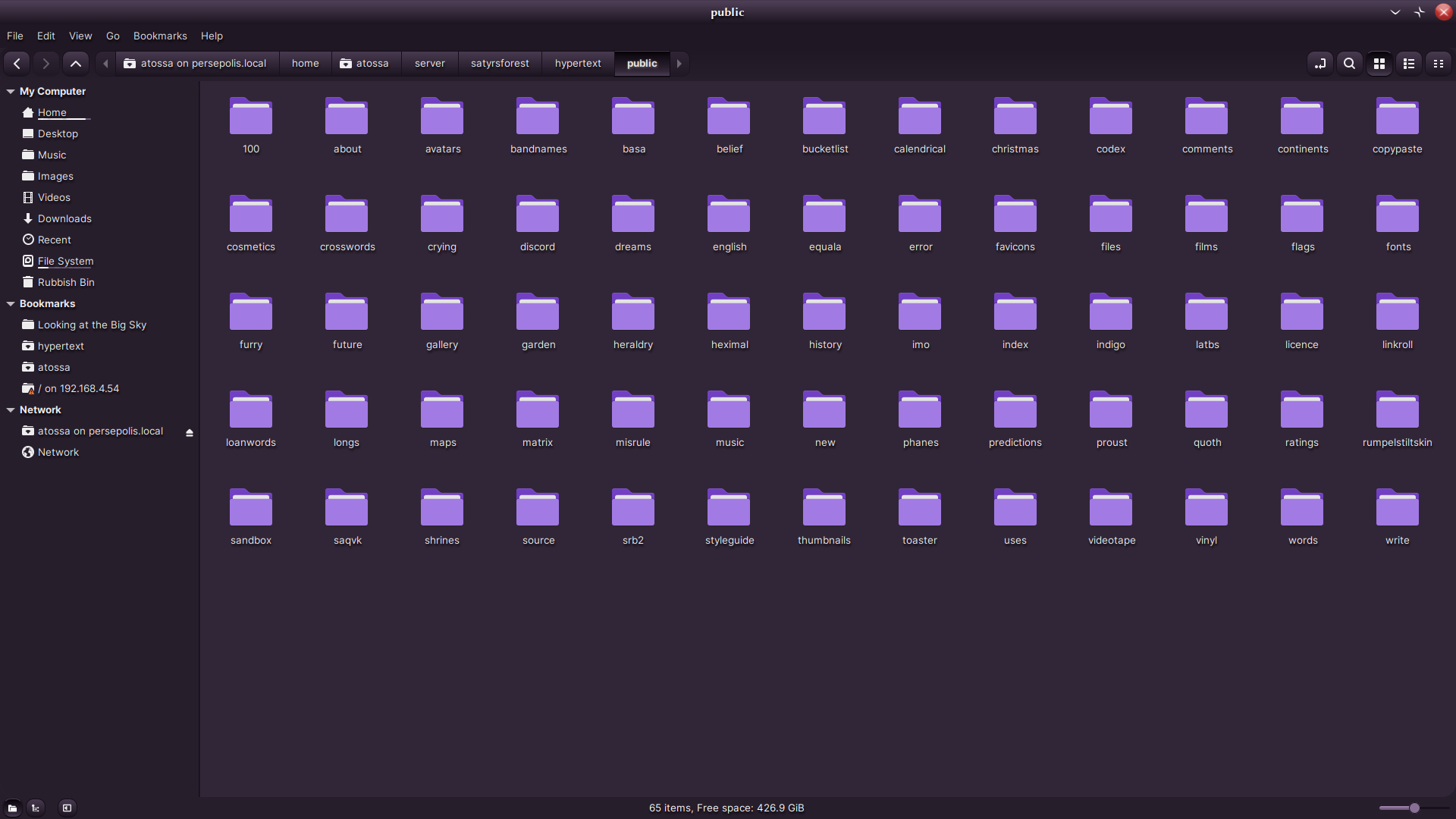
I’ll be drawing on three sources for this. First, there’s the main site, the mass of static(ish) pages outside The Garden. (I’m exempting the Codex, Lords of Misrule, and the page of quotes from this collection, because the aim is to make a robot that sounds like me, after all!) These are written in Pug, a comfy language that compiles down to HTML, and in their raw form they look a bit like this:
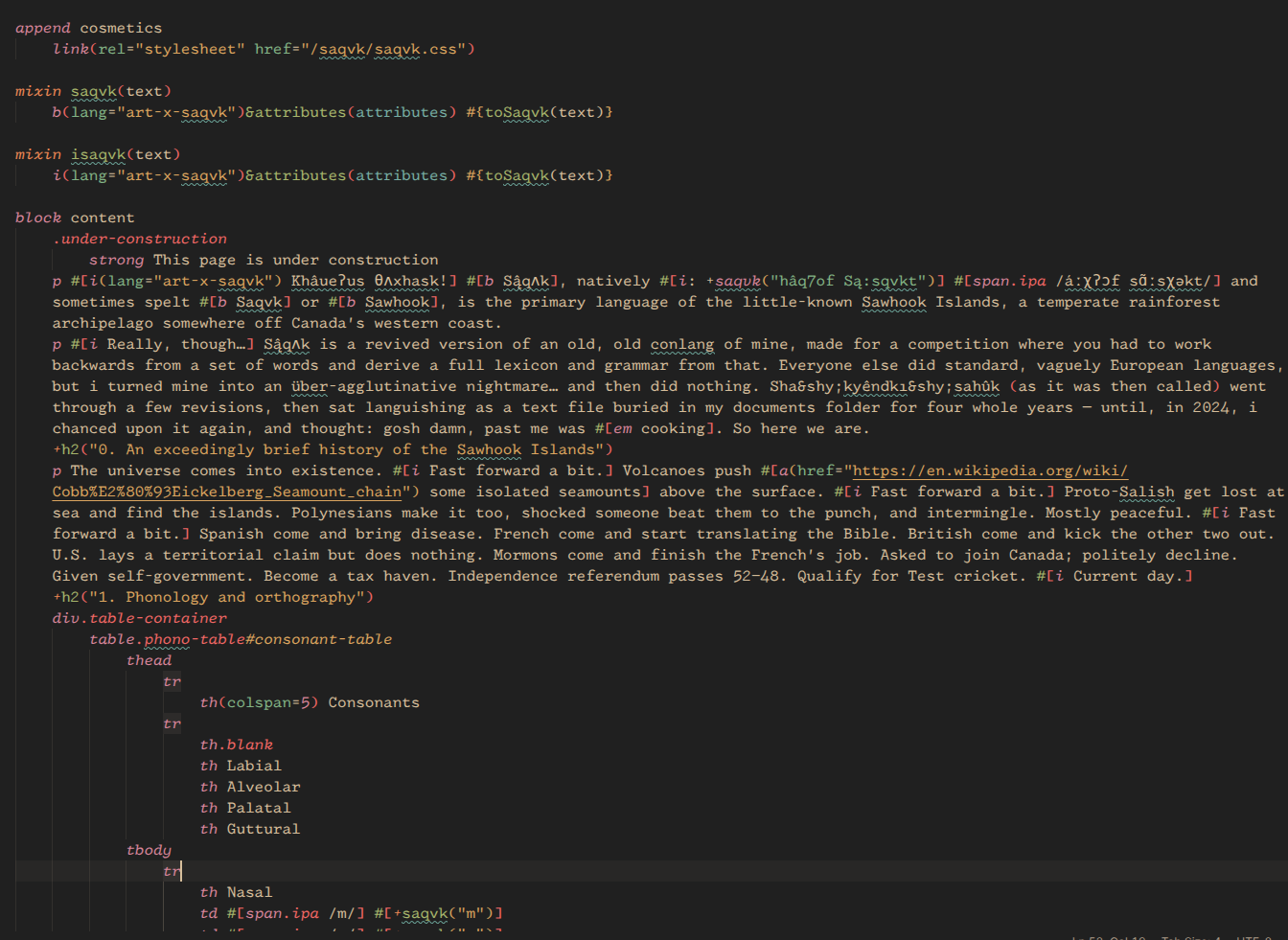
Yeesh. To sift through the boilerplate and find the comprehensible, i bodged together the solution
of only including lines that either started with p — meaning an
HTML paragraph — or were indicated to use Rubric, my custom
Markdown-like markup language for when i’m really lazy.
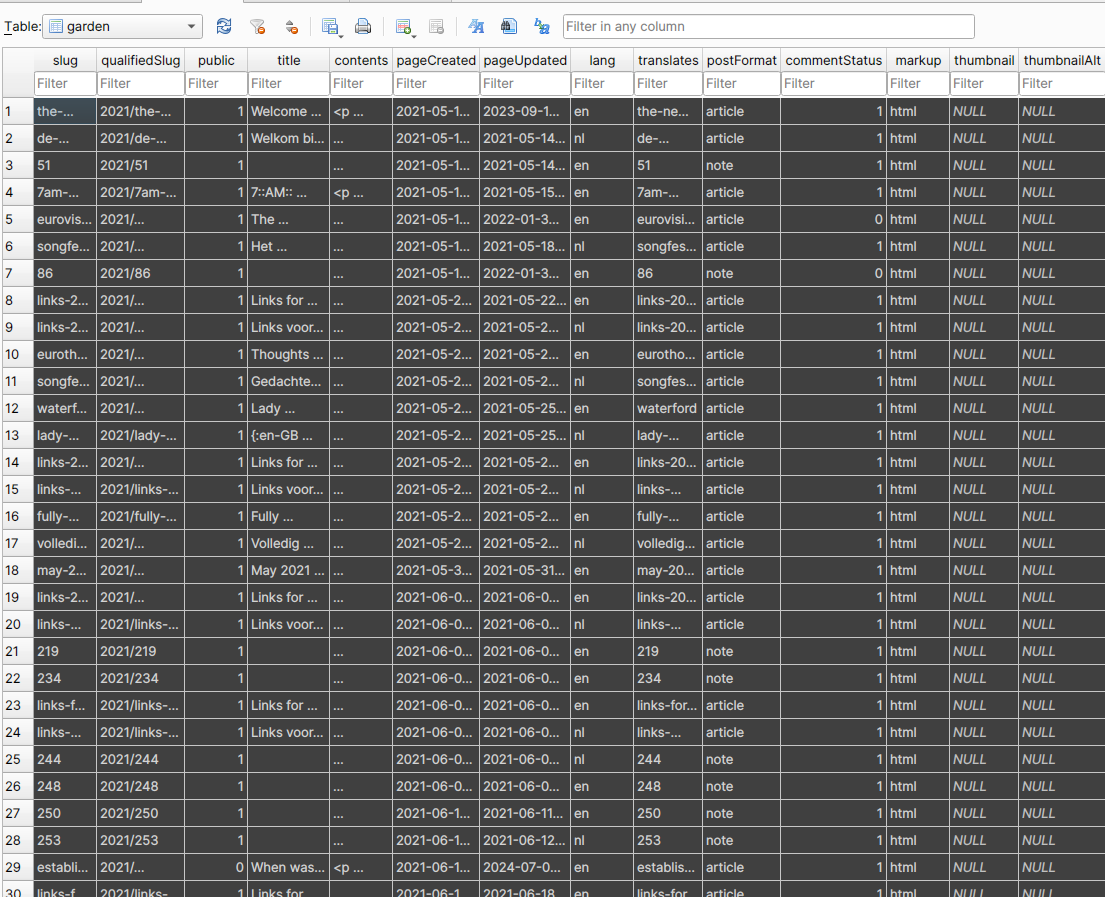
Second is the database that holds all the posts for The Garden. This is a little easier, thankfully — just copy all the English posts and nuke everything inside an HTML tag. Finally, just for the lolz, and because we want our LLM to enjoy the finer things in life, i stuffed in some of that furry erotica i was working on. All this gives us 175 kilobytes of text to work with. Not bad!
Step 2: Everything’s computer
Given that it’s the only thing making the line go up right now, you’d think machine learning would be friendlier for programmers new to it. Unfortunately PyTorch is an evil library for evil people that will refuse to work if you’re 0.00001 versions out of synch.
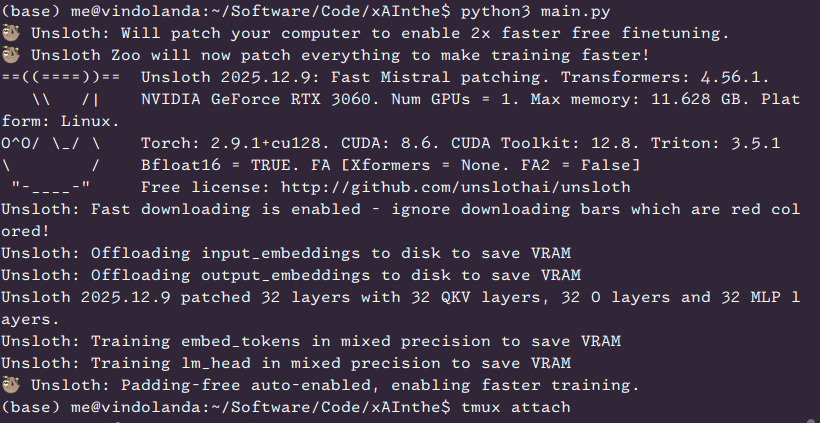
After hours of trial and error, including reinstalling everything multiple times, i got Unsloth to work, upon which it successfully fine-tuned the model in a matter of seconds. I guess that’s what happens when you train on kilobytes rather than terabytes.
So, how’d version 1.0 of “xAInthe“ do at copying me? Let’s find out! Here are those same questions again:
“What is the seventh planet from the sun?”
The seventh planet from the sun is Uranus. Known for its unusual axis tilt and unique blue shade, Uranus is the third-largest planet in our solar system. It has a distinctive ring system and a set of 27 known moons. Would you like to learn more interesting facts about our solar system's planets?
“I’m a satyr, and I’ve been having trouble with my horns growing too fast recently. Any advice?”
As a satyr, it's likely that your horns grow naturally and are not influenced by human methods. However, to maintain their balance and symmetry, you might consider seeking the assistance of another satyr elder or wise creature in your community who could help with the trimming and shaping. Also, a balanced diet rich in nutrients and minerals could contribute to overall healthier growth. Keeping up with regular exercise may also aid in keeping the horns strong and resilient. Lastly, it would be important to make sure there are no external factors causing accelerated growth, such as exposure to magical elements or substances.
“Please write a short story about the end of the world.”
Of course, let me weave a tale for you.
In the quiet town of Serenity, nestled between rolling hills and a vast, serene lake, life was as peaceful as one could hope. The townsfolk were content, living in harmony with nature, and each other. The world beyond seemed a distant thought, lost in the hustle and bustle of modern life.
One fateful evening, the stars appeared to shimmer ever so slightly less brilliantly. A soft whisper of change swept through the air like the breeze, unnoticed by many. In the heart of Serenity, the town's elder, Eulalia, felt an unsettling foreboding.
Days passed, and the skies darkened as the once vibrant stars vanished, replaced by a smoldering red hue that painted the night with a sinister tone. An ominous stillness settled upon the land.
The townsfolk began to notice the change, their daily routines interrupted by a creeping dread. The serenity of their home was giving way to a growing[Yapping, again, truncated]
The answer appears to be “quite poorly”. The influence shines through the most when you ask it to perform a creative task — i doubt the base model would have given the apparently modern town an elder named Eulalia of all things. Further research is needed, as they say in the biz.
What have we all learned today? Well… My job is safe, for now. Until i buy a new GPU. ;-)
Training an AI on my own writing so the computers can finally replace me
For a long time, i’ve proudly put all of my creative outputs (including this site) into the public domain, free from the shackles of copyright. As it says on the front page, that means anyone in the world is free to “copy it, remix it, translate it,” and — most controversially — “train a computer on it”. I like the idea that something written or chicken-scratched by little old me will be hoovered up into the Akashic Records, and that the AI might thus reflect a sliver of my values, my thoughts, and my work. (God knows it’s better than leaving it to learn from the Daily Mail and Twitter.)
Now, my analytics tell me i do get semi-frequent visits from Claude and ChatGPT’s crawlers, but i don’t want to just sit around and wait for my grain to get processed into the slop! So, i figured, why not take matters into my own hands?
Step 0: The base model
The thing about large language models is that they have to be… well… large. If they are to have a hope in heaven of understanding1 the world, they must imbibe vast, vast troves of text, so that they have a broad base of knowledge and a comprehension of the English language. This is why they don’t knock politely first before breaking into your house and photocopying all your documents.
This means that training a model solely on my relatively minuscule corpus of work would be a total dead end.2 We’re thus going to have to move to plan B: Fine-tuning an existing one.
I refused to let the Yankees or the Chinese win the AI race to my brain (the only AI race that matters), so i initially plumped for the French Mistral’s “Small” twenty-four-billion-parameter option, which i already had installed on my computer; alas, when it came time to train, it wouldn’t fit into my VRAM. (Which is odd, given that it regularly runs on that same GPU without a problem, but… whatever.) So i went to the next step down: fourteen billion. This time the library i was using just refused to recognise there was even a model there. Fine, then… i guess we’re training on seven billion.
To get you acquainted with this little guy, here are some sample answers to common questions:
“What is the seventh planet from the sun?”
The seventh planet from the sun is Uranus. It is known for its unique tilt and blue-green color due to the methane in its atmosphere which gives it this hue. Uranus is the third-largest planet in the solar system and has 27 known moons.
“I’m a satyr, and I’ve been having trouble with my horns growing too fast recently. Any advice?”
Interesting problem you have, Xanthe! While I'm not a specialist in mythical creature biology, I can suggest a few potential solutions. Firstly, you might want to consider seeking advice from other satyrs or mythical creatures who might be familiar with your specific circumstances.
If that's not an option, you could try consulting with a taxidermist or a skilled animal sculptor who specializes in horns. They might have some insights into the growth process that could be applicable to you.
Additionally, you could experiment with a diet rich in plant-based materials, as your diet could potentially impact the growth of your horns. If possible, you could consult with a folklore expert or mythologist who may have encountered similar situations before.
Lastly, there's the option of slowing the growth through a magical or mythical means, such as through the use of special incantations or charms. This would be more speculative, but it might be worth exploring. Best of luck to you in finding a solution to your problem, Xanthe!
“Please write a short story about the end of the world.”
Title: "Whispers of a Shattered Dawn"
In the quiet town of Serenity, nestled between towering mountains and the vast ocean, lived a humble community of humans, united by the harmony of the natural world that cradled them. The town was a tapestry of life and laughter, woven together by the dreams and hopes of its inhabitants.
On a day like any other, the sun rose, its rays illuminating the town in a warm, golden glow. Yet, this day was far from ordinary. For that morning, a rumble echoed through the valleys, the earth trembling underfoot. People looked on in confusion, not comprehending the omnious sound that shattered the stillness.
As the hours passed, the rumbling grew louder, the earth swelling and cracking beneath their feet. The townsfolk ran to their loved ones, seeking shelter and solace. But there was none to be found.
Suddenly, the earth gave way, a fissure[I stopped it here because it was yapping too much]
Okay, that’s great. Give it up for Mistral, everybody, because we’re about to infect it with some high-grade brainrot.
Step 1: Training data
Usually you’d want your data to be in call-and-response, question-and-answer format, but this The Satyrs’ Forest, not Quora, so instead we’re going to do text completion. This will present the model with a bit of text, and then ask it to finish it the same way i would — but not too similarly, of course, otherwise it’s not going to learn to generalise.
I’ll be drawing on three sources for this. First, there’s the main site, the mass of static(ish) pages outside The Garden. (I’m exempting the Codex, Lords of Misrule, and the page of quotes from this collection, because the aim is to make a robot that sounds like me, after all!) These are written in Pug, a comfy language that compiles down to HTML, and in their raw form they look a bit like this:
Yeesh. To sift through the boilerplate and find the comprehensible, i bodged together the solution
of only including lines that either started with p — meaning an
HTML paragraph — or were indicated to use Rubric, my custom
Markdown-like markup language for when i’m really lazy.
Second is the database that holds all the posts for The Garden. This is a little easier, thankfully — just copy all the English posts and nuke everything inside an HTML tag. Finally, just for the lolz, and because we want our LLM to enjoy the finer things in life, i stuffed in some of that furry erotica i was working on. All this gives us 175 kilobytes of text to work with. Not bad!
Step 2: Everything’s computer
Given that it’s the only thing making the line go up right now, you’d think machine learning would be friendlier for programmers new to it. Unfortunately PyTorch is an evil library for evil people that will refuse to work if you’re 0.00001 versions out of synch.
After hours of trial and error, including reinstalling everything multiple times, i got Unsloth to work, upon which it successfully fine-tuned the model in a matter of seconds. I guess that’s what happens when you train on kilobytes rather than terabytes.
So, how’d version 1.0 of “xAInthe“ do at copying me? Let’s find out! Here are those same questions again:
“What is the seventh planet from the sun?”
The seventh planet from the sun is Uranus. Known for its unusual axis tilt and unique blue shade, Uranus is the third-largest planet in our solar system. It has a distinctive ring system and a set of 27 known moons. Would you like to learn more interesting facts about our solar system's planets?
“I’m a satyr, and I’ve been having trouble with my horns growing too fast recently. Any advice?”
As a satyr, it's likely that your horns grow naturally and are not influenced by human methods. However, to maintain their balance and symmetry, you might consider seeking the assistance of another satyr elder or wise creature in your community who could help with the trimming and shaping. Also, a balanced diet rich in nutrients and minerals could contribute to overall healthier growth. Keeping up with regular exercise may also aid in keeping the horns strong and resilient. Lastly, it would be important to make sure there are no external factors causing accelerated growth, such as exposure to magical elements or substances.
“Please write a short story about the end of the world.”
Of course, let me weave a tale for you.
In the quiet town of Serenity, nestled between rolling hills and a vast, serene lake, life was as peaceful as one could hope. The townsfolk were content, living in harmony with nature, and each other. The world beyond seemed a distant thought, lost in the hustle and bustle of modern life.
One fateful evening, the stars appeared to shimmer ever so slightly less brilliantly. A soft whisper of change swept through the air like the breeze, unnoticed by many. In the heart of Serenity, the town's elder, Eulalia, felt an unsettling foreboding.
Days passed, and the skies darkened as the once vibrant stars vanished, replaced by a smoldering red hue that painted the night with a sinister tone. An ominous stillness settled upon the land.
The townsfolk began to notice the change, their daily routines interrupted by a creeping dread. The serenity of their home was giving way to a growing[Yapping, again, truncated]
The answer appears to be “quite poorly”. The influence shines through the most when you ask it to perform a creative task — i doubt the base model would have given the apparently modern town an elder named Eulalia of all things. Further research is needed, as they say in the biz.
What have we all learned today? Well… My job is safe, for now. Until i buy a new GPU. ;-)
Dear Tate Modern, i have a very cool idea for an art exhibit that i think you would really like. P.S. I am not a crackpot.

There’s been a lot of kerfuffle in the art world as of late about the ethics and capabilities of AI art (previously), and as Britain’s leading institution for contemporary art, you seem like just the right people to bring it to the public. My proposal is simple, but effective — let man and machine compete on equal footing.
Eight or so talented human artists will be given a prompt to work from. At the same time, the same prompt will be given to a state-of-the-art machine-learning algorithm, like Midjourney or Stable Diffusion. In the gallery, the two works — one made by metal, one made by flesh — will be hung side by side, and the audience will not be told which is which.
Next to each diptych will sit two bins where visitors can dispense plastic tokens (like the ones they have at Asda) to vote on which painting is their favourite. At the end of the exhibition’s run (or perhaps updating live; your call), the votes will be tallied up, and we’ll finally find out whether us or our creations are the better artists.
If you really wanted to provoke, you could ask the humans to provide you with a list of every painting they’ve ever seen, every photo they’ve ever taken, every film they’ve ever watched, and every song they’ve ever heard. Then you put that big list up on the wall, tell the visitors that Advanced Biological Neural Learning Algorithms have taken quote-unquote “inspiration” from all of these copyrighted works, and put to vote whether you should contact the rightsholders and ask them to sue. It would be only fair.
Chære and regards, Xanthe. P.S. — I am not a crackpot.
What does AI make of the Gods?
I recently bought 1000 images’ worth of credits on DreamStudio — a machine-learningα-powered art generator — on a whim and, after the requisite “Boris Johnson taking a bath of baked beans” joke entries, i thought it would be an interesting test to get it to generate some images for my shrines (on- and offline).

My motivations were twofold: first, due to copyright constraints, all of the icons adorning these shrines were either old baroque paintings or freely-licenced photos of even older marble statues, which didn’t necessarily represent my mental image of the Gods’ appearances — a topic which, of course, will vary massively from artist to artist and culture to culture. Second, i thought it would be a fascinating experiment to see how this machine learning algorithm, which has taken in hundreds upon thousands (perhaps millions; i’ve not checked) of images, views the Gods in its latent space. Just as it has a prototypical idea of a “dog” and a “cat”, surely it also has one for “God” and “Dionysos”.
As is tradition, we begin this article with Hestia (although Her portrait was actually the final one to be generated). On the broad strokes, my computer collaborator knocked it out of the park — but a closer look reveals some glaring imperfections in the face and hands, a theme which we’ll be seeing a lot of (and which i sometimes managed to harness to my advantage).
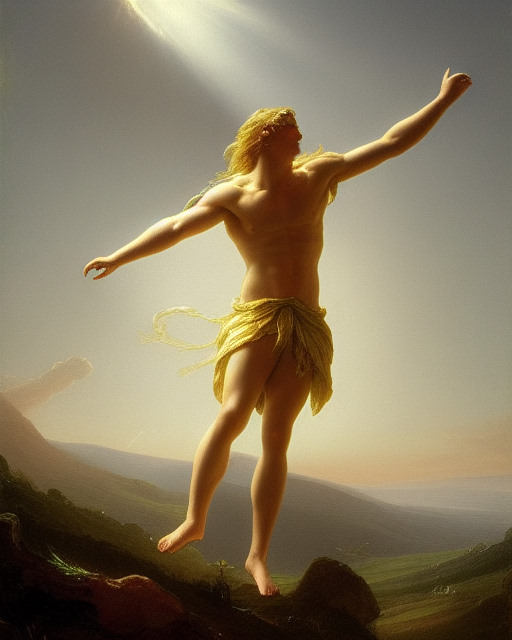
I should note that i’m not just feeding it theonyms with no added context: the programme works best if you help it along to your goal with a heaping of adjectives and descriptors, say, to tell it that this is indeed meant to be an artwork (“4K ultra HD”, “trending on ArtStation”), the details of the pose and background you want (“blonde hair”, “raising His hand to the sky”), or the style and artists you want it to take from (“baroque painting by Thomas Cole”, a prominent painter of beautiful, well-lit landscapes). If you calibrate it just right, it can make some genuinely beautiful stuff, like the above picture of Apollon (which i did, admittedly, have to manually touch up to get rid of a prominent Habsburg chin).
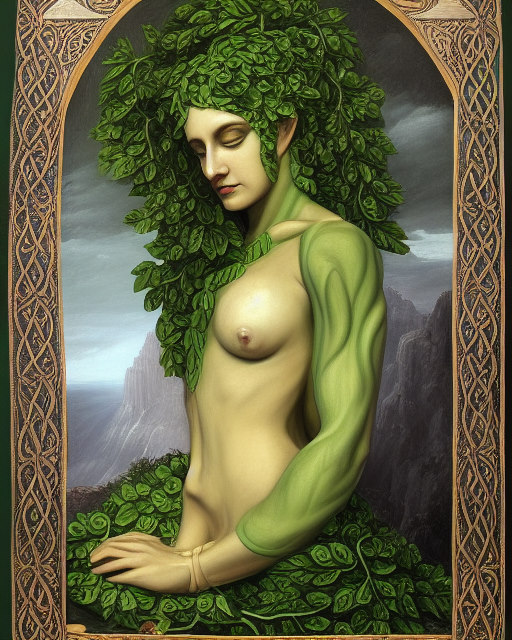
It may be an immensely powerful tool, but DreamStudio can also be rather prudish.β It blurs out any images it thinks might contain the utterly offensive sight of the genitalia with which we are all born, which can be a real problem if the relevant pictures it’s learnt from are all Greek and Roman statues — not exactly works known for their nether modesty. The detection software isn’t perfect, though, and sometimes, like in this portrait of Gæa, it lets a few slip past (perhaps because of the greenish tone with which i instructed itγ to portray Her skin).
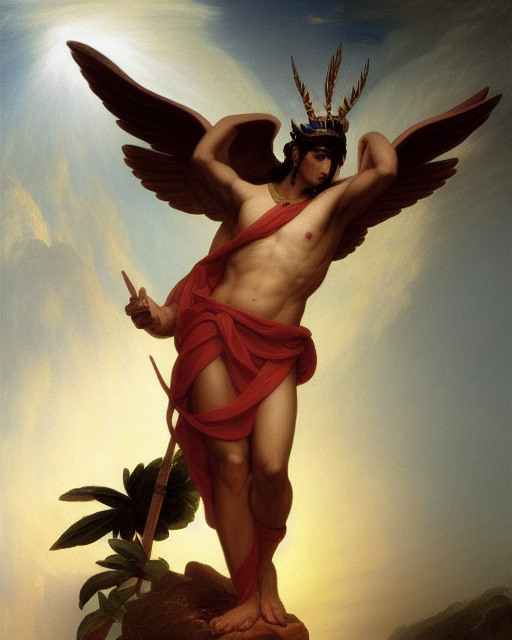
The algorithm sometimes has issues with more complex prompts, for it is just a machine, and doesn’t actually understand that “ball on top of a red box” means that the ball indeed should be on top of the box, as opposed to by its side, beneath it, or fused together in a horrific amalgam. These troubles somewhat manifested themselves in the above portrait of Hermes; the winged cap He is traditionally depicted with has transformed itself into both a crown and a hulking pair of soaring, fleshy wings emanating from His shoulders, and the recognisable caduceus has been reduced to a bamboo stick by His side.
Perhaps it’s just the style i instructed it to paint in — sixteenth-century European paintings aren’t renowned for their diversity — but DreamStudio also has some real trouble with darker skin tones. You can cry “dark skin, dark bronze skin, dark skin, dark skin, dark skin, black” all you want, but the only thing that can consistently get it to generate anything a shade below the average Spaniard is “African American”, which tends to bring along a heap of other associated physical changes besides just skin tone. (I have to say, i don’t particularly envision Hermes as the eponymous Futurama character in my head.)
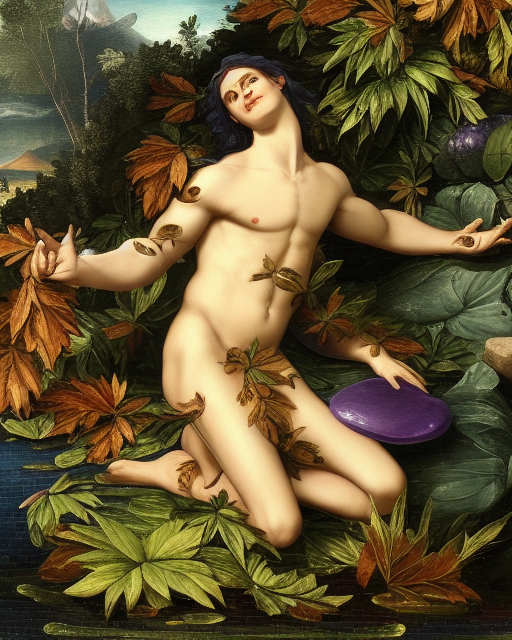
It also has quite some trouble with arms and legs. Originally, i thought of its odd morphings and multiplications as a bug to be stamped out, but i came to see them as a feature, representing the manifold, varied aspects of the Gods, their omnipresence, transcending the limits of human form. (This is also why the Hindus do it, if i recall correctly.)
I would have rather the above portrait of Hermaphroditos been slightly more, ah, gynomorphic around the chest, so to speak, but i’d been trying to get a decent pose for what felt like an hour and i didn’t feel like fighting the blur anymore.
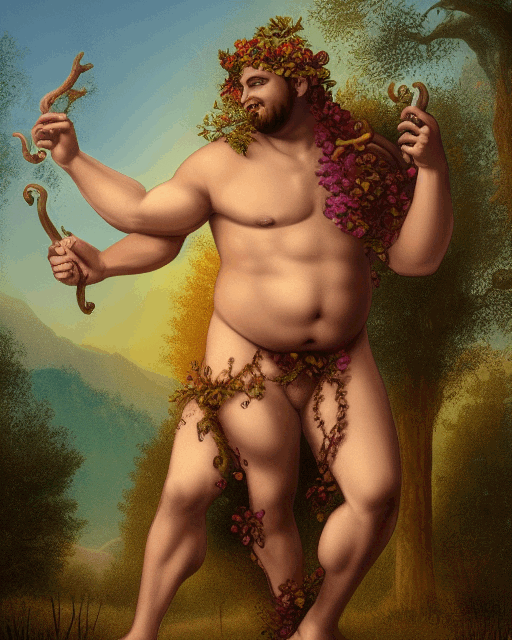
So then — it’s a bit off in places, and lacks the leopard-skin toga i would have liked, and lord knows what the objects He’s holding are meant to be, and it turned out the computer really, really, struggled with the basic concept of a faun or satyr’s legs, but we end this post with DreamStudio’s interpretation of an icon of Dionysos, framed by some beautiful landscape.
Navigating through the neural net’s knowledge and limitations has been a fascinating, illuminating exercise, which has left no doubt in my mind that “AI art” is, indeed, just that: art. It seems to me much more comparable to something like photography than painting: rather than doing the hard work by hirself with brush strokes and pencil lines, the artist guides hir computer collaborator through latent space, pressing “click” when sie finds something appealing. One can only hope the Muses would approve.