The family and i went to a local food-and-craft market at Ponteland’s garden centre this morning. I
thought i’d send letters of recommendation for some of the stalls.
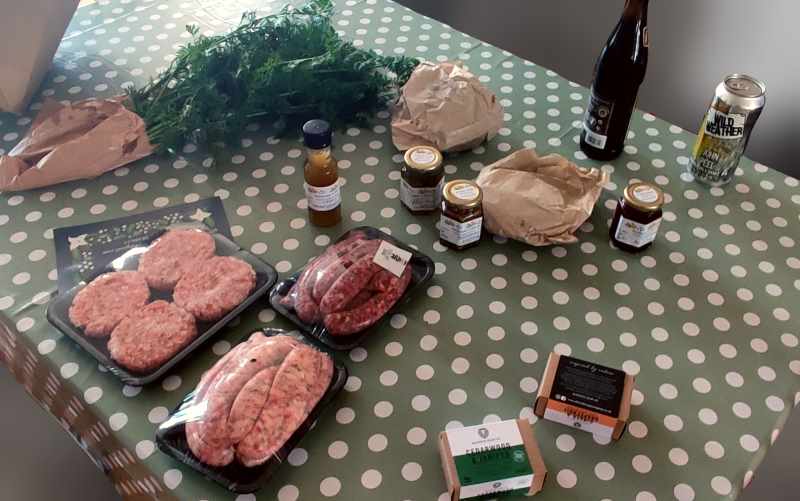
Urban Bakery, from Gateshead, make the most decadent cinnamon buns i’ve ever had.
Mrs B’s Kitchen, from Durham, sells jams, conserves, chutneys, honey, sauces — all the things you ever need in the
top drawer of your fridge. (I got the rhubarb and raspberry.)
Hops and Dots, of Bishop Auckland, make “accessible craft beer” with Braille on the labels.
Wilde Farm, of Ponteland, are ostensibly running the whole thing, and sell... you know, farm things. Carrots,
veg, burgers, sausages, turkey — you get the idea. They’re currently taking
orders for the winter holidays.
Last time on The Garden: A strip mall turns out to be a place of immense historical curiosity, i am interrupted by a
rude troupe of boy racers, and find myself caught up in the lyrics of a pro-union folk song.
Leaving Seghill, going past a house with a conspicuous
Northumbrian flag, the
landscape once again slips swiftly back into ruralia — a common occurrence on this leg of the
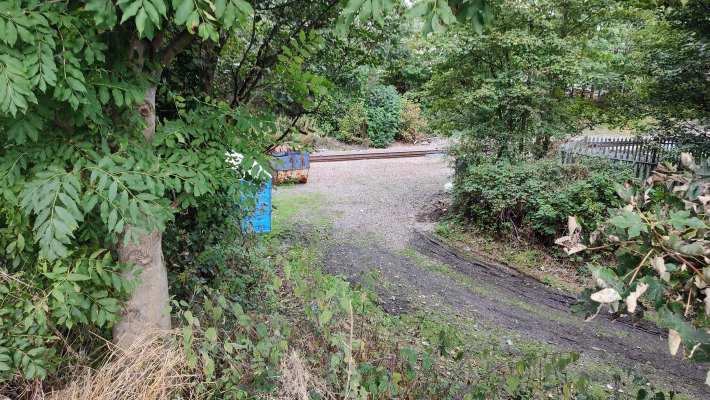
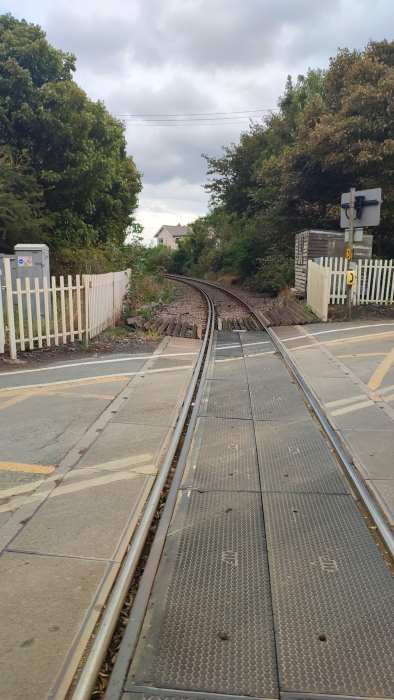
journey. No sooner had i left behind the station house than i found myself on a dirt path which i
wasn’t quiiiite sure i was meant to be on.
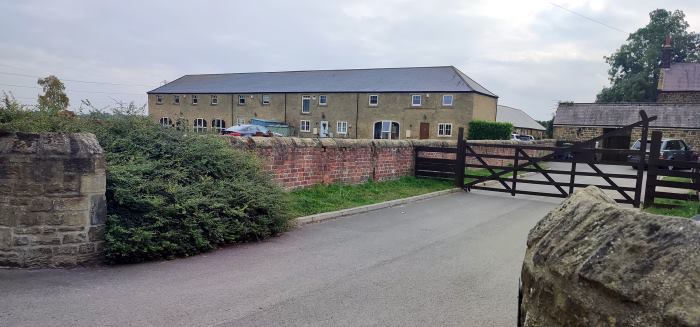
This was the small hamlet of Mare Close, essentially a farmhouse surrounded by a few cottages. I
have a sneaking suspicion that everyone living there has been friends since primary school, though
i'll never know for sure. Opposite the cottages, by the next leg of my route, lay a
small village church and
graveyard which i dared not enter. Onwards.
Seaton Delavalα sits at the heart of the valley. Turning
one way, there lies a charming local coöperative store, a
genuine lordly manor (owned by
the town’s namesake De la Val family, who came over after 1066), the
previously-blogged village of Holywell, and, eventually,
the seaside settlement of Seaton Sluice.β Unfortunately, we’ll be turning
the other way, by where once stood a colliery.
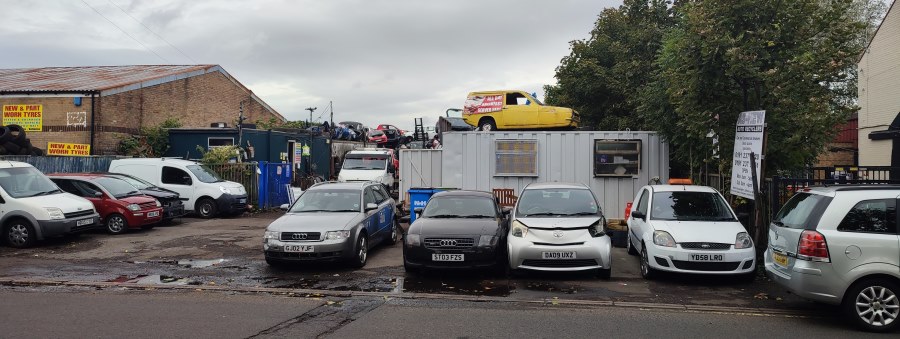
The former site of Delaval’s station can hardly be considered a sight for sore eyes. Cars and
lorries pass by, horns blaring, trying to weave their way between those turning into the nearby
petrol station.γ The location of the station itself is an uninspiring gravel
pit on one site with an overgrown nettle-filled path on the other; next door is a chain pub whose
car park will be getting embiggened to accommodate the extra traffic once the railway reopens.
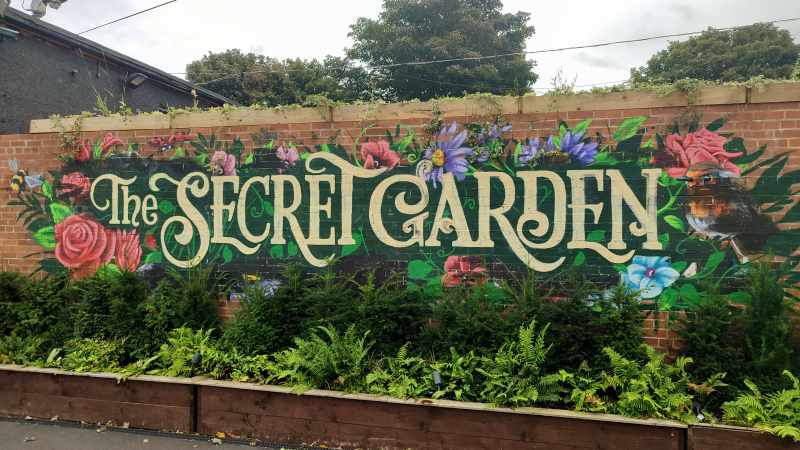
It doesn’t get much better. A few interesting-looking eateries (a grimy-looking café called “Only
Fools and Sauces”, a venue by the name of the
Secret Gardenδ with a wonderful
hand-painted sign) added some initial spice, but soon i was back to the same industrial wasteland:
Auto recycling! Furniture wholesalers! Caravan storage! Chemical producers! The works!
...I said something about a colliery, didn’t i?
16 January, 1862. It’s half past ten — or, at least, it might be. You’ve been labouring
away in the coal pit since two in the morning, and you’ve not seen the sun since. The shift is
almost over, and it’s time to swap over with the next group.
One by one, your comrades file in line to get out. A huddle of people enter the rusting lift. The
familiar ketter-ketter-ketter shudders through the cave — but then, for a fraction of a
second, all falls silent.
Your heart races. A drop of water falls from the ceiling. Nobody makes a sound.
And then, all of a sudden, it is as though Thor’s hammer has crashed
into the ground. The earth around you shakes in terror, lets out what can only be described as an
otherworldly scream, as ten tonnes of blood-red steel smash into the floor.
This was the
Hartley Pit disaster, and its shockwaves can still be heard across town.
Just across from the telltale jackhammers and yellow tape of a housing estate so new Google Maps
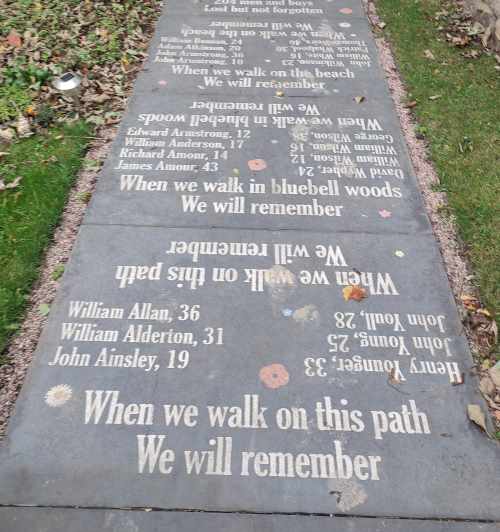
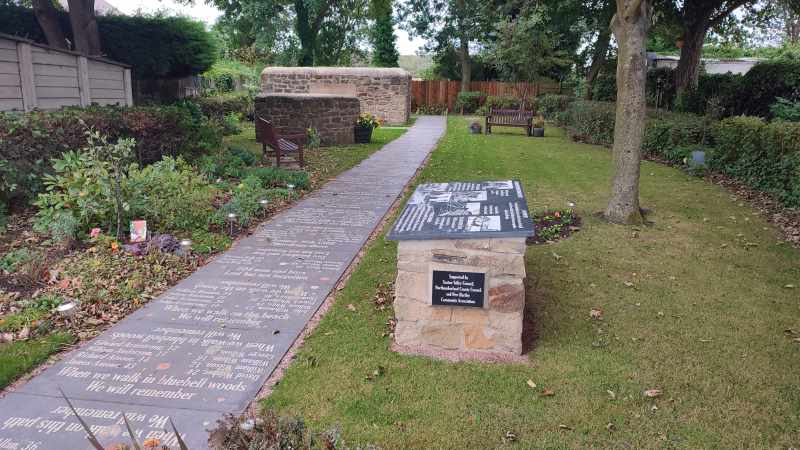
hasn’t caught up yetε sits a lovely memorial garden, explaining the story of
the tragedy, with a poem to contemplate as you ramble along the path.
In terms of stations, the town has had two — Hartley and Hartley Pit — both right next to each
other, and neither seeming to have any chance of reopening.
I was a bit anxious about continuing on, because there were several serious-looking men in hard-hats
and high-vis jackets, but they didn’t seem to mind. They really, really should have tried to stop me
from going to where i was going next.
Coming up on The Garden: your author tries not to disturb some horses, desperately tries to avoid going to fucking
Blyth, and accidentally sneaks in a brief trip to Durham. I promise, it makes sense in
context.
Last time on The Garden: the axe falls on the Blyth and Tyne line, and i foolhardily decide to walk its length…
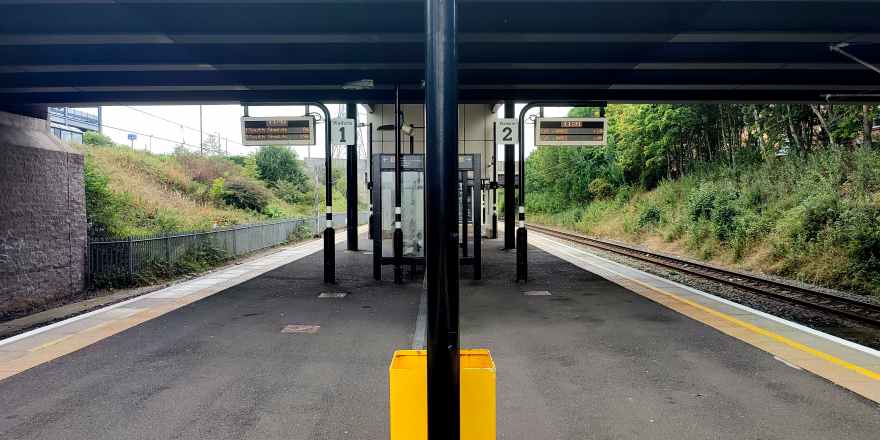
Our journey begins at Northumberland Park, in North Tyneside. Though it’s the
first station we’ll be visiting, it was the last to be constructed, having only opened in 2005 — and
it’s quite easy to tell, even after sixteen years of wear and tear; the place is outfitted with
modern amenities, lifts, ticket machines flush with the wall, and, more lately, pandemic-themed
graffiti opposite the platform. This unassuming metro station will, according to the county
council’s plans, serve as the interchange between the old and new lines, heavy rail and metro
meeting one last time before splitting apart and going their separate ways.
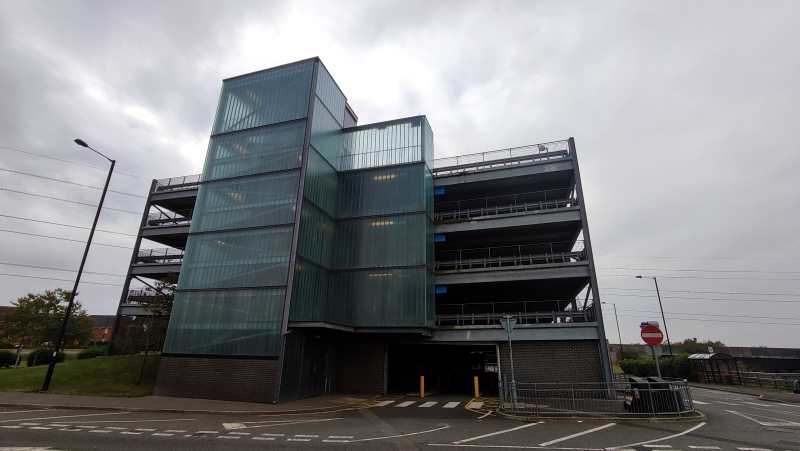
Setting off from there, the first thing that caught my eye were twin giants: a frosted glass-covered
car park and a red-brick Sainsbury’s, unexpected icons of the modern British condition. It didn’t
get much better from there; down the road lies an American-style strip mall lined with bookmakers
trying to get people to piss away all their money.
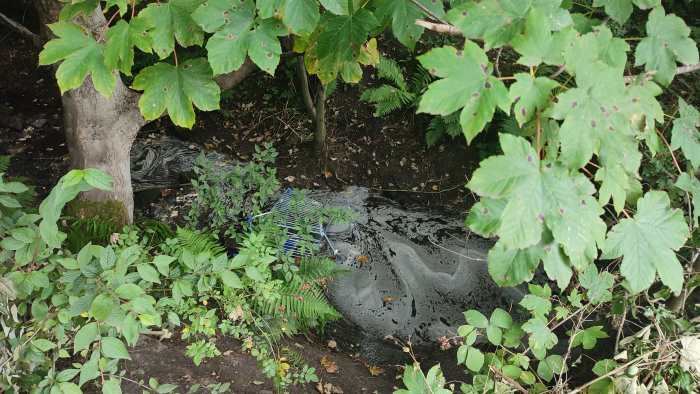
This sorry-looking trolley was, i presume, abandoned from the local Sainsbury’s.
This southernmost tip of Northumberland is criss-crossed by innumerable public footpaths, cycle
paths, bridleways, and other routes for non-metal-box-related transport; ducking onto one of the
reclaimed
“waggonways” once used
to transport coal, i found myself on the site of the second station on the list.
The leafy suburb of Backworth has a habit of burying its history.
A hoard of offerings from Roman times
was found underground in the 1810s, the last vestiges of the colliery that once was are long gone,
and the tale of this sorry ex-station is rather similar. Opened in 1864 to replace a nearby station
closing the same day, Backworth station served its community for over 100 years, surviving the
Beeching cuts. But when the Tyne and Wear Metro was announced to come to town, the old station
finally closed… for good. It wasn’t until the opening of Northumberland Park that there would be
a replacement.
As i wandered through the village's verdant streets, i couldn’t help but think of its resemblance to
the straight, cycle-friendly streets of my old hometown. A little greenery can go a long way.
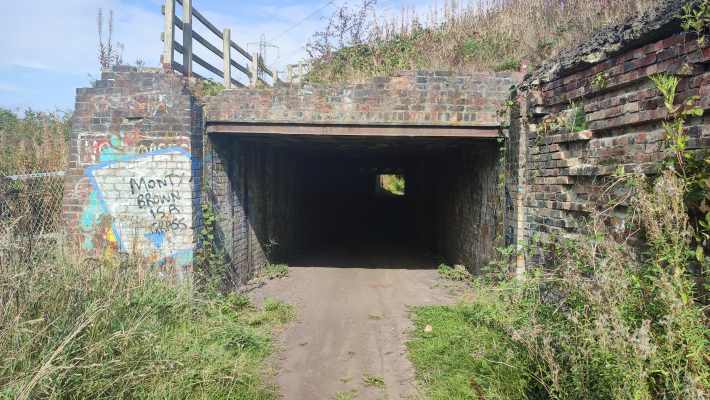
The graffiti reads “Monty Brown is a grass”. I would never say such unkind things about Mr
Brown.
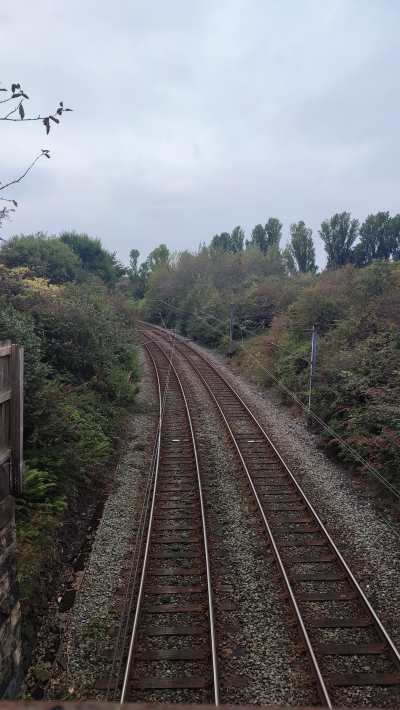
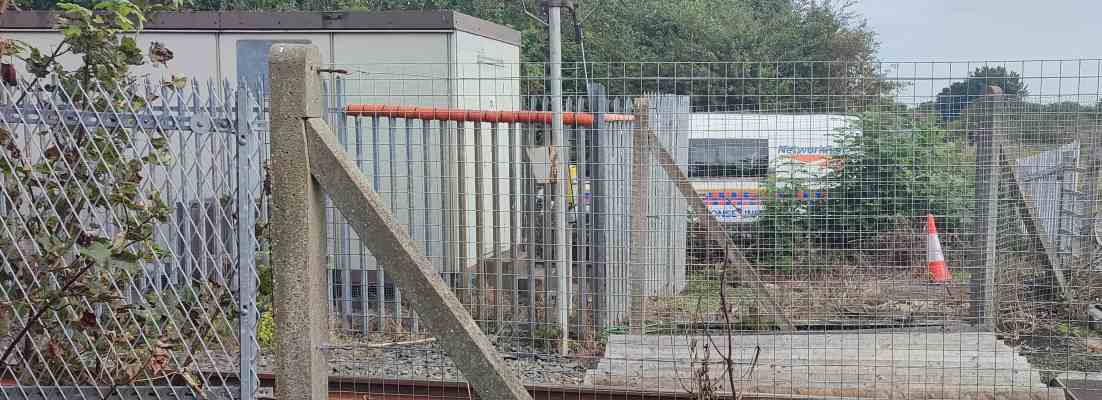
Network Rail were hard at work at the site of the aforementioned original Backworth station, whose
plot of land now sits vacant, marking the city’s last hurrah; the further i walked along the dirt
back roads, the further the sounds of bustling cars receded, until, ducking under a shady underpass,
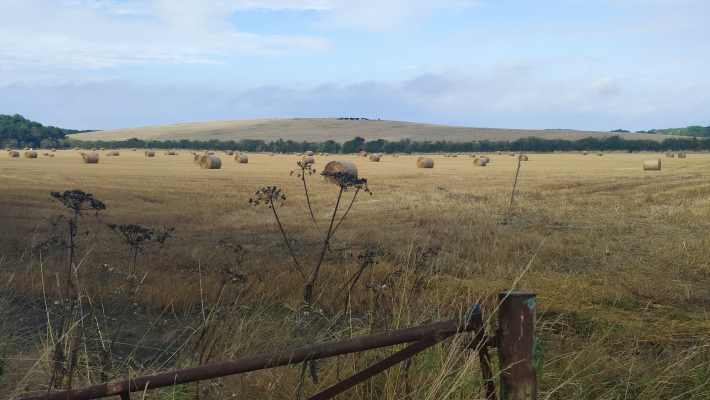
i found myself utterly alone amongst pastoral fields (and the overwhelming scent of manure).
That peace and quiet was swiftly interrupted by a troupe of boy racers on motorcycles and
quad-bikes, but you can’t win them all, you know?
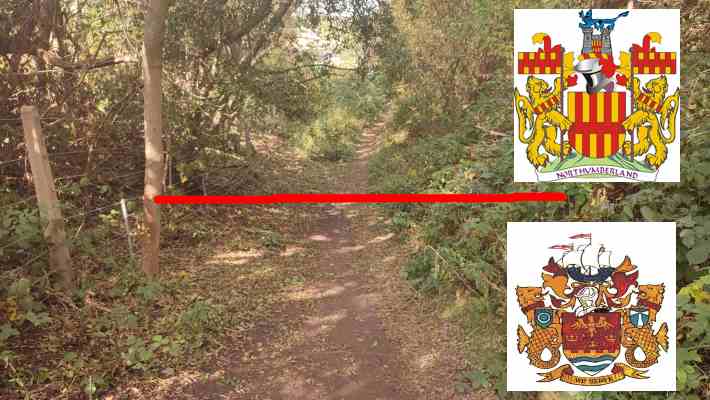
After the county borders were hacked up in 1974, this line became the divider between rural
Northumberland and ostensibly-urban Tyne and Wear.
The (post-1974) border town of Seghill occupies only the tiniest fragment of the
collective English consciousness, popping up briefly in an anti-scab miners’ folk song called
“Blackleg Miner”:
It’s in the evening after dark, when the blackleg miner creeps to work With his
moleskin pants and dirty shirt there gans the blackleg miner!
[...]
So, divvint gan near the Seghill mine Across the way they stretch a line, to catch the
throat and break the spine of the dirty blackleg miner
[...]
So join the union while you may Divvint wait till your dying day, for that may not be
far away, you dirty blackleg miner!
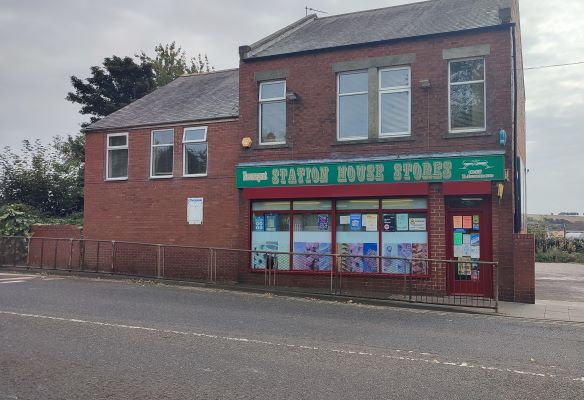
For our purposes, it’s chiefly notable for the fact that it’s the first disused station on the list
whose buildings are still intact and in use, this time as a corner shop, from which i of course
bought a copy of the local rag — prominently including a
Q&A about the restoration of service on the line, which i
thought a fitting reminder of why i set out on this silly old journey in the first place.
After getting some well deserved rest, i headed on off towards the next town over, awaiting what
fresh stories i would find...
Next time on “Walking the Blyth and Tyne”: your author is reminded of her own mortality, finds
himself in the company of a noble family, and shudders at the thought of having to go to Blyth,
of all places on Gods’ green Earth
It’s March of 1963. The island of Great Britain is in the throes of its coldest winter in two
decades, senior frontbench MP Harold Wilson was recently handed the
reins of the Labour party, the Beatles have just released their debut album, and, somewhere in the
bowels of Whitehall, Dr Richard Beeching is writing a report that will change the country’s
connecting tissue forever.
Dr Beeching, you see, is the chairman of British Railways, the state-owned company in charge of rail
transport, and they’re in a spot of financial trouble. British Railways are in charge of running
fifteen thousand miles of track shuttling between about four and a half thousand stations, and the
only way they can do that is via generous subsidies from Her Majesty’s Government — something which
the governing Conservatives, as a rule, are never too happy about.
So, pen in hand, he takes a metaphorical axe to the network, marking about half of the island’s
stations for closure. It’s not pleasant, but it has to be done — and, after all, people can just
take the car to their nearest station if their town’s is shut.i I’m sure it
won’t be too bad.
That's how, a year later, the last passenger trains ran along 5,000 miles of railway across England,
Scotland, and Wales, including those connecting the mining heartland of industrial Northumberland.
The Tyne and Wear Metro, opened in 1980, allowed some of these lines to reopen in Newcastle’s
suburbs and (relatively) affluent coastal communities. But just a few miles north, the former Blyth
and Tyne Railway has lain dormant ever since the axe fell… until now.
In recent years, the stars have aligned, and both the county council and Westminster have agreed to
reopen the line, finally bringing these proud towns back together. The Blyth and Tyne Railway, now
rechristened by the more attractive name of the
Northumberland Line, is set to reopen by 2024. To celebrate this historic moment, i thought i’d see what has become of
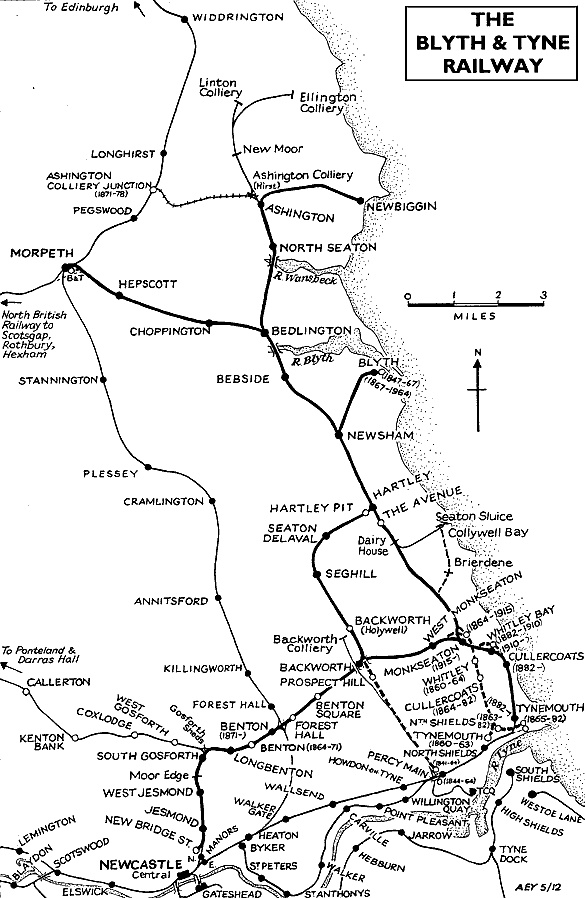
the stations and towns that were. I’ve identified fourteen stations, past, present, and future,
along the line, and i’ll be walking between each of them in turn, seeing what stories they tell. The
list includes:
Northumberland Park, the metro station ready and waiting to become the new
line’s interchange
Backworth (the second)
Backworth (the first), already long closed by the time the axe fell
Seghill
Seaton Delaval, planned for reopening
Hartley Pit / Hartley, two old stations just metres apart
Newsham, planned for reopening
Blyth, on an old branch line
Blyth Bebside, planned for reopening
Bedlington, planned for reopening
North Seaton, now subsumed within Ashington’s town area
Ashington, planned for reopening
Woodhorn, listed on early plans for reopening but mysteriously disappeared since
Newbiggin-by-the-Sea, no longer in existence but with the route there safeguarded just in case
The Victoria Tunnel runs beneath the streets of Newcastle, from the Tyne up to the Town Moor. It
traverses not only space, but time, through nearly every corner of England’s history: built to
transport coal in the Industrial Revolution, on the site of an old Roman spring, it was used during
the second world war to house those fleeing German bombs. It was even considered for use in the cold
war, before the government realised that some musty old coal tunnels would probably not provide the
greatest protection against a nuclear blast.
And now you can go down it. In 2007, Newcastle City Council decided to refurbish the tunnel and open
a small stretch of it — the rest is either unsafe for sending humans down or currently in use as a
sewer — up for public tours. Entry is via a side street along the Ouseburn, where the guides will
cheerfully show you a map and some old photographs of the entrance. Once you get inside the tunnel
itself, hard hats and torches are compulsory, and covid restrictions are still in full force. This
was both a benefit and a malefit: yes, the tour was shorter than it would otherwise be, and masks
get quite uncomfortable when you’re wearing them for an hour in a dank, dark tunnel, but on the
other hand, our small group of family and friends got the place practically all to ourselves,
without having to be shepherded alongside other members of the public.
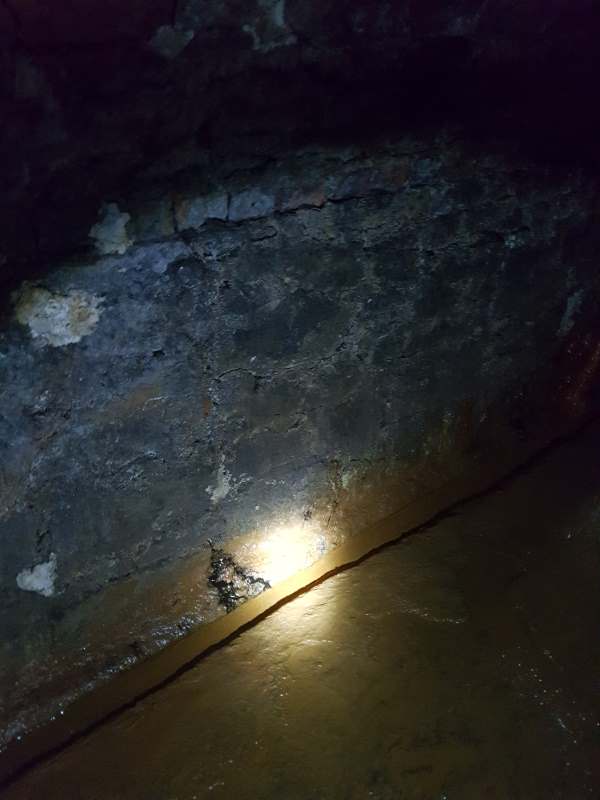
The water from the ancient Roman spring is directed through a side channel, to avoid it getting
all over the tunnel floor. Sometimes it even works!
The tunnel is just barely wide enough to fit three people side-by-side, and if, like me, you’re of a
certain height, bumping your head on the roof is practically guaranteed. By every blast door,
there’s a plaque about what’s above you, and how it factors into the tunnel and the city’s history,
stories with which the guides will gladly regale visitors (including some rather grim tragedies).
Coming back out the entrance, i felt more informed about this wonderful county’s industrial history
— just in time to pop over to a gentrified vegan “superfood pub”. The wonders of modern life.
Price: £9–11 per adult depending on the length of the tour; £4 per child
Address:
Victoria Tunnel Entrance, Ouse St., Valley, Newcastle upon Tyne
NE1 2PF
— just next to the CrossFit gym.
Accessibility: The tunnel was built in the 19th century and without
accessibility in mind, so is not wheelchair-accessible. The Ouseburn Trust do, due to the
pandemic, offer a virtual tour.
Getting there: The Q3 bus from the centre of town
stops nearby; otherwise, getting there poses a bit of a hike, due to its location.
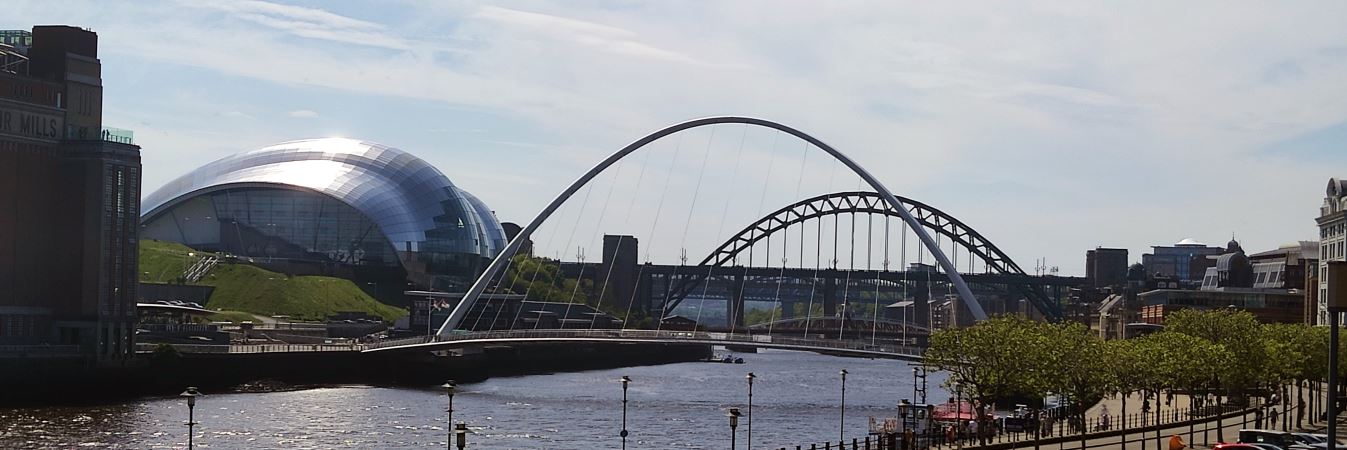
The gorgeous gorge that is the Tyne valley has no shortage of winsome views, but the most beautiful,
in my opinion, is that which appears to one who goes down the Side.α In the
Monument’s shadow, after passing the classical columns of the Theatre Royal and descending Grey
Street as it becomes Dean Street, finally taking a turn onto the Side at the bottom, the lucky
traveller will find themself towered over by the behemoth that is the Tyne Bridge:
The rotting wooden stairs, as seen on Google street view.
I’m not sure any photograph can ever match what it’s like to be there under that bridge. One of the
most remarkable things about this view, though, has nothing to do with the view itself, but rather
what happens if one walks down the Quayside for a little while, reaches an empty brownfield plot,
and clambers up a set of rotting wooden stairs to its right. Because, inexplicably, just a few
metres from the most beautiful view in town, one can find the second most beautiful view in
town, a glorious lookout on every bridge linking the two banks of the river.
We don’t deserve this city.
I had initially neglected to bring a water bottle along with me; i had only intended a quick jaunt
to the centre of town and back, and the foolhardy idea of walking all the way to Wallsend came to me
spontaneously. This quickly proved a bad idea, and so i made a trek up to the corner shop, who
thankfully had all the bottled water anyone could ever want or need.
After leaving fully rehydrated and ready to walk back, i noticed the most wonderful little thing. A
parklet, this small opening of green space with some benches and inscriptions, tucked between a
housing area and a construction site. I took some pictures — i would have loved to show them to you,
but alas, my phone got stolen in the intervening time between this trip and me writing this post,
taking the photographs with it.
Nevertheless, if you’d like to visit (or live vicariously through Google street view), it’s that
little park adjacent to 5 Belmont Street. (Google stubbornly refuses to give a proper address, but
you can’t miss it!)
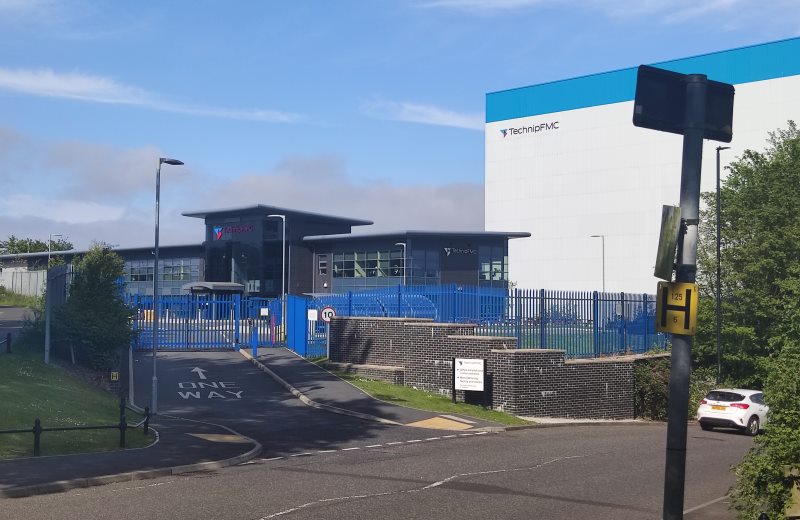
An account of my thought process upon seeing the above building complex:
That building looks exceedingly evil, but i can’t quite place my finger on why…
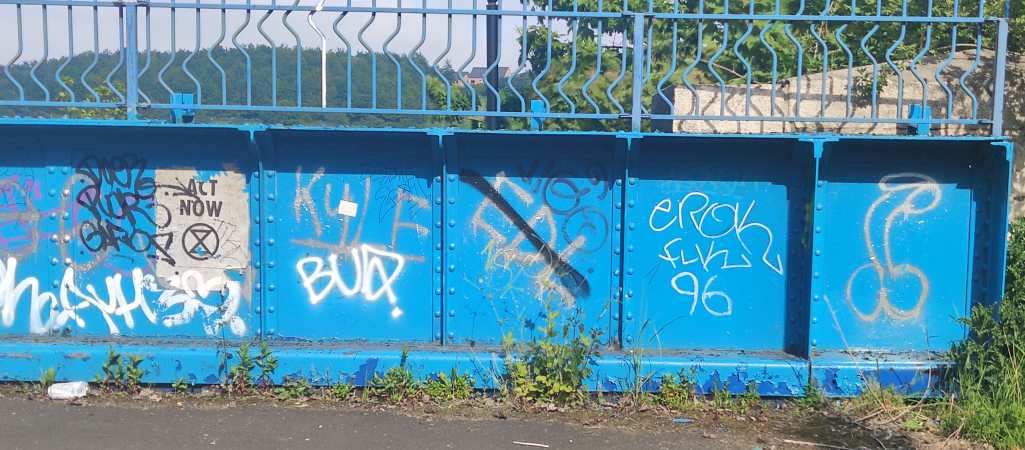
Just a few yards ahead, crossing a foot-and-cycle bridge, i happened upon some strikingly relevant
graffiti, alongside some other pieces which really sum up the modern English psyche: an Extinction
Rebellion poster, a crossed out “EDL”,β and a cock and
bollocks.
I carried a record from HMV (the Killers’ Hot Fuss, if you must
know) the whole way, and let me tell you, my arms were positively aching by the end of it! At least
i had a bag…γ
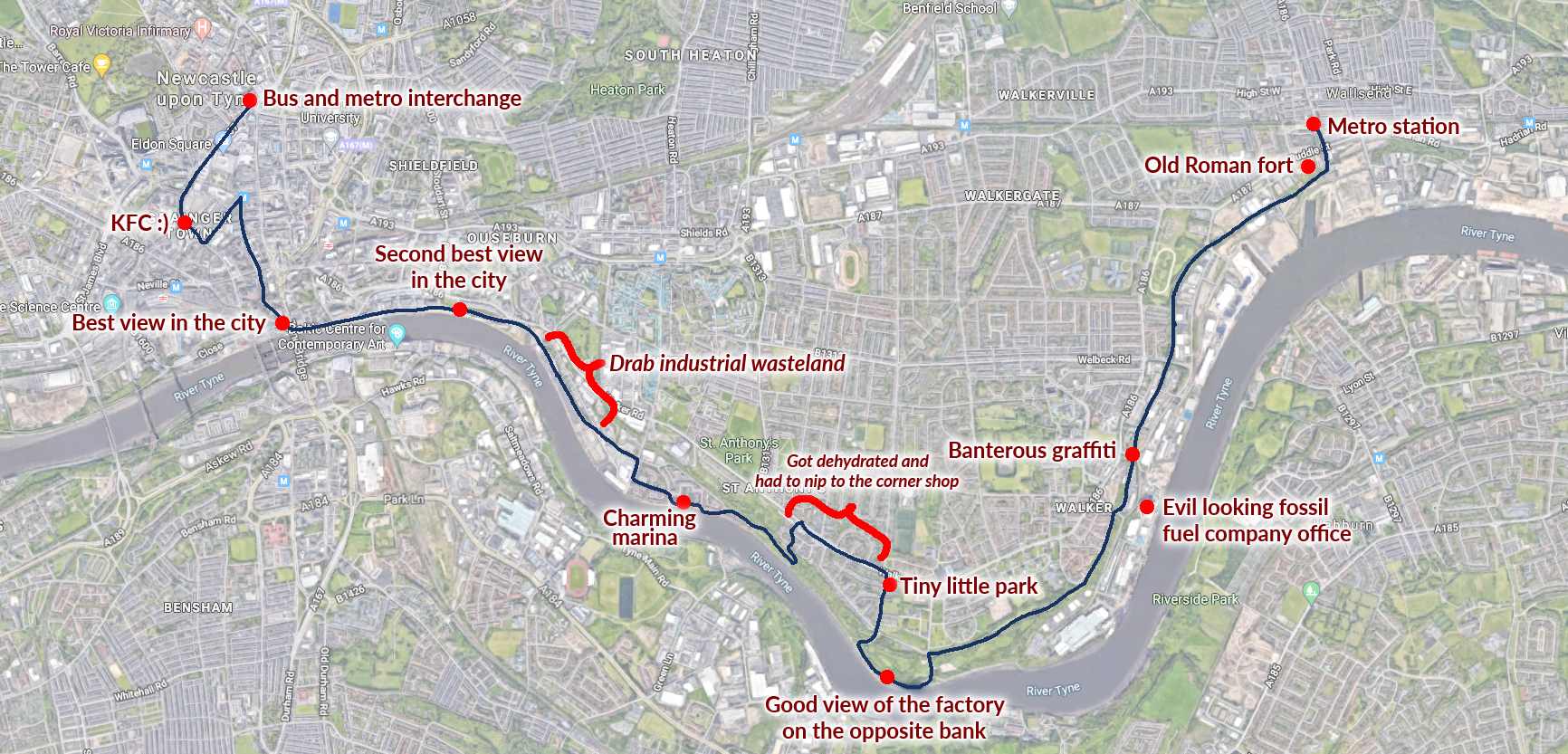
To sign off, here are some photos whose stories weren’t interesting enough to make the cut, as well
as a map of the journey. Thank you for reading this disjoint mess.
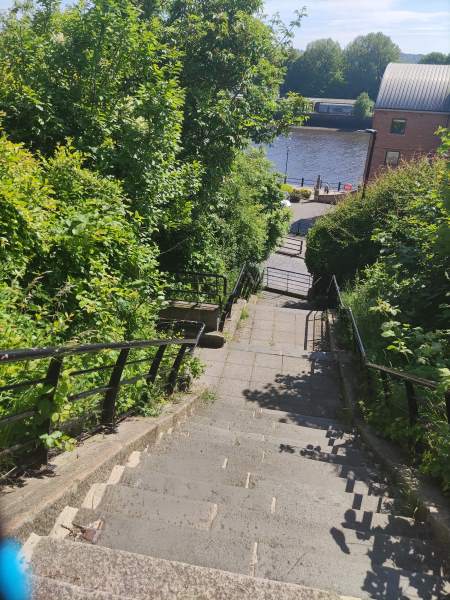
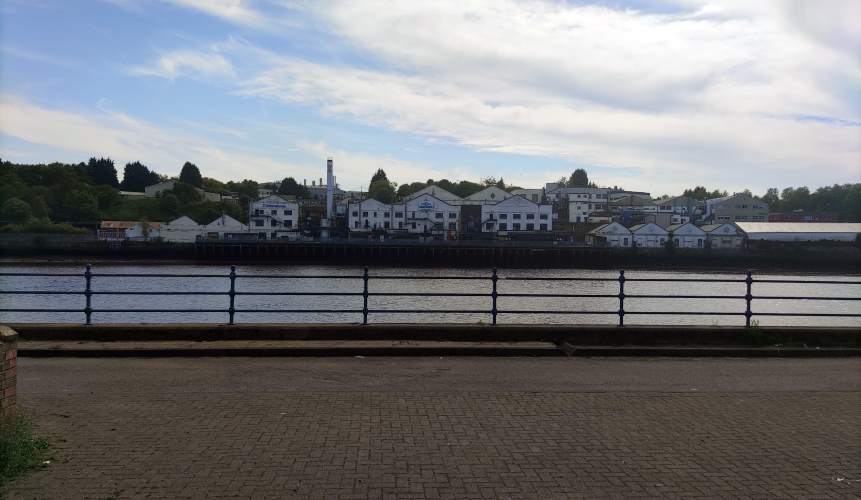
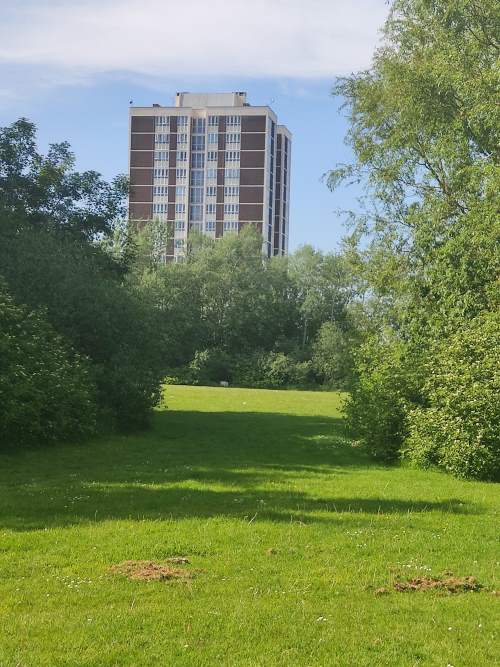
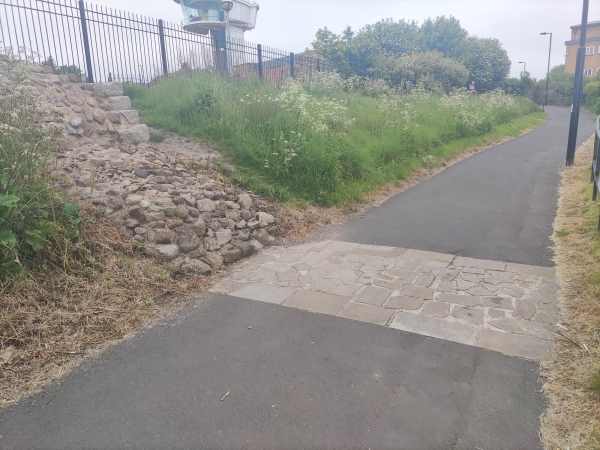
Top left to bottom: A picture looking downwards from shortly after the second best view; a nice
view of the AkzoNobel factory on the opposite bank of the river; some tower; and the literal
wall’s end of Wallsend.
Ik weet niet hoe sommigemensen
het doen, bijna elke dag een nieuw artikel schrijven. Misschien is mijn leven gewoon niet
interessant genoeg ervoor…
Hoe dan ook. Ik was van plan een volledige post te schrijven over een recente uitstap naar
Lady Waterford Hall, maar mijn geheugen is verschríkkelijk en volgens mij zou het niet erg interessant zou zijn. In
plaats daarvan, hier zijn wat foto’s van de reis:
Wijzend naar de cadeauwinkel.
"De Student". Deze foto is een beetje meer potato quality dan de rest, want het
schilderij zit achter een glazen lijst…
(Mogelijke bezoekers: De toegang is gratis met een voorgestelde donatie van drie pond, en het museum
is rolstoeltoegankelijk.)
I don't know how
somepeople do it,
posting almost every day. I suppose my life just isn’t interesting enough for this sort of thing!
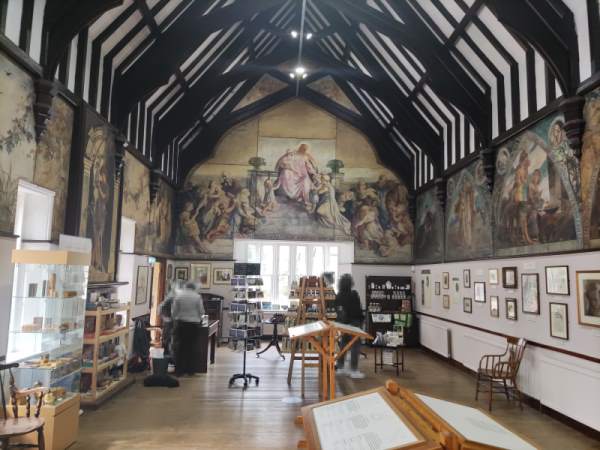
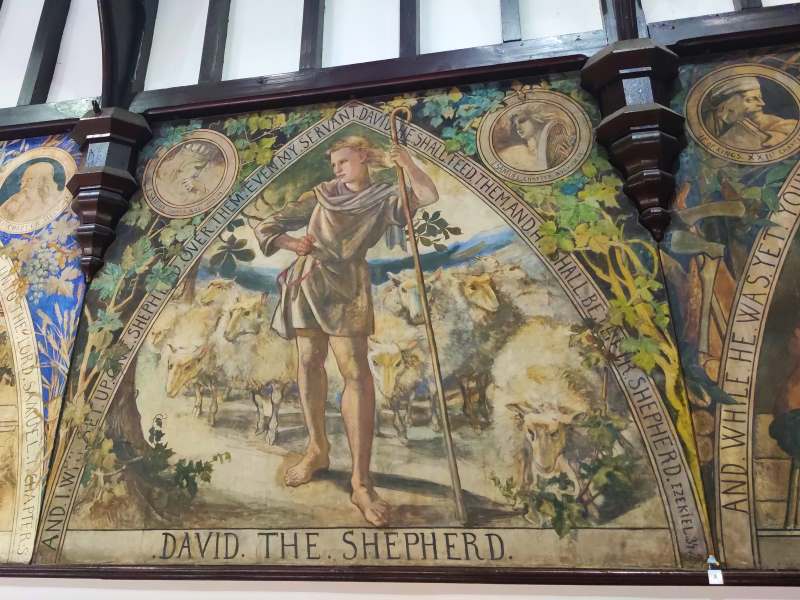
Anyway. I was going to write up a full post about a recent jaunt to
Lady Waterford Hall, but my memory
is awful and i’m not sure that it would be very interesting. Instead, here are some photos
from the trip:
Pointing towards the gift shop.
“The Student”. This photo’s a bit more potato-y than the rest, because it was behind a glossy
frame…
(If you’d like to visit, admission is free with a suggested donation of £3, and the place is
wheelchair-accessible.)